This article was reviewed by Sarah Mitchell, CFP® for accuracy. This article will be updated when SSA announces the final 2026 COLA in October 2025.
Disclaimer: This is not tax or financial advice. Always consult a licensed financial advisor or CPA for your specific situation.
Your 2026 COLA Notice Is Incomplete
A Cost-of-Living Adjustment (COLA) is an annual increase in Social Security benefits designed to offset inflation, calculated based on the Consumer Price Index for Urban Wage Earners and Clerical Workers (CPI-W). However, the COLA does not directly account for healthcare costs, which often rise faster than general inflation.
Last updated: April 2026 — This article projects the 2026 COLA and Medicare Part B premiums based on current law. The Social Security Administration announces the final COLA in October each year, and CMS announces final Medicare premiums in the fall. We'll update this article when official figures are released.
You open your mailbox and see the notice from the Social Security Administration. Your monthly benefit is going up by 2.8%1 starting in January 2026. For a moment, you feel a relief. Inflation has been biting, and every little bit helps.
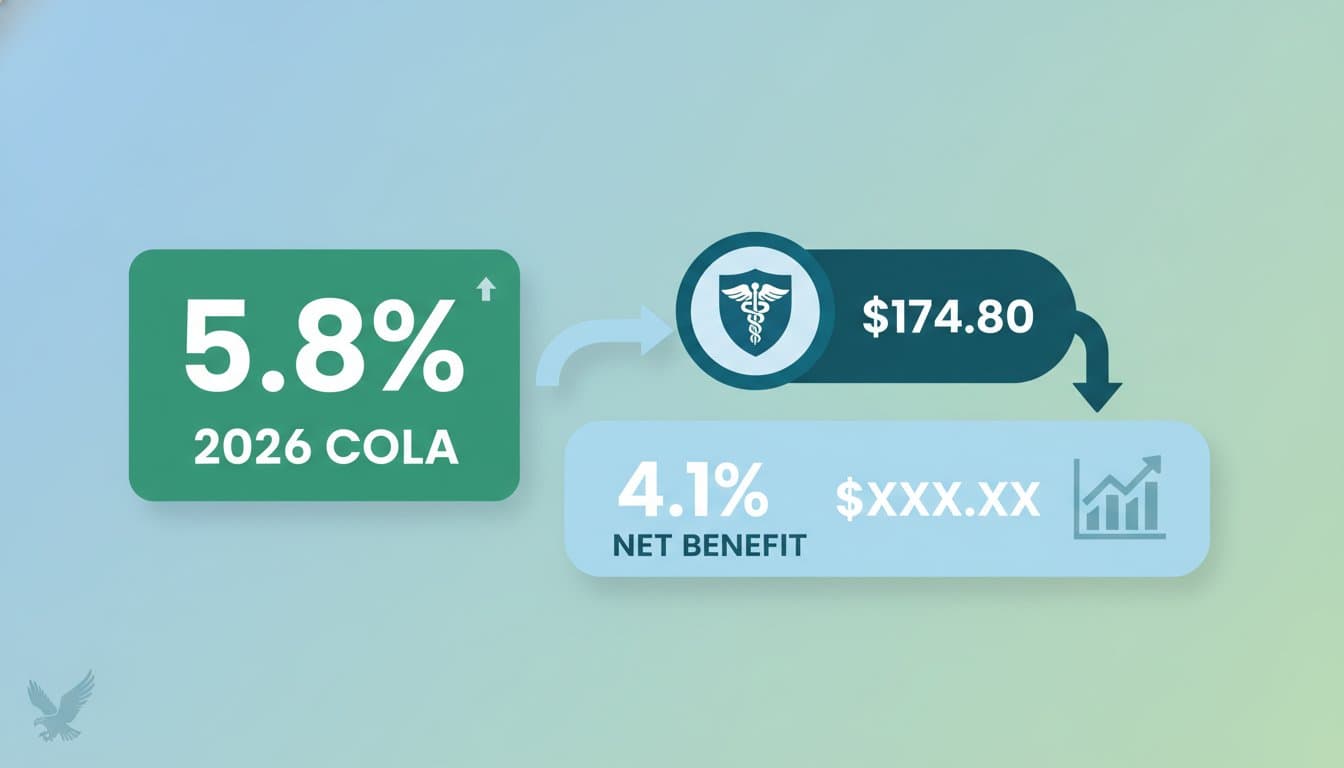
Then, you remember last year. Your check didn't go up as much as the COLA percentage promised. The reason? Medicare Part B. The premium for outpatient medical coverage is automatically deducted from most Social Security benefits before the money hits your bank account. The 2026 Social Security COLA is the annual Cost-of-Living Adjustment designed to help benefits keep pace with inflation, but it doesn't account for the specific, often faster-rising cost of healthcare.
If you're a freelancer or independent contractor planning your retirement income, this distinction is critical. You're used to managing variable cash flow and understanding net income after expenses. Your Social Security benefit works the same way. The gross COLA is not your net gain.
This article will cut through the headline number. We'll show you exactly how to calculate your 2026 Social Security net benefit after the Medicare Part B deduction and other costs, so you know if your purchasing power is truly increasing.
How the 2026 COLA and Medicare Part B Work Together
First, let's establish the baseline numbers. The Social Security Administration announced a 2.8%1 COLA for 2026, based on the increase in the Consumer Price Index for Urban Wage Earners and Clerical Workers (CPI-W) from the third quarter of 2024 to the third quarter of 20251.
Medicare Part B is the component of Medicare that covers outpatient care, doctor visits, preventive services, and durable medical equipment. The standard monthly premium is automatically deducted from most Social Security benefits.
Simultaneously, the Centers for Medicare & Medicaid Services (CMS) sets the Medicare Part B standard monthly premium. For 2026, the standard premium is projected to be $202.903 per month for most beneficiaries. This is an estimate based on current law and cost projections; the final figure is announced in the fall of 2025.
Here's the crucial mechanism: For the vast majority of beneficiaries who have Part B premiums deducted directly from their Social Security check, the government applies a "hold harmless" provision4. This rule states that your net Social Security benefit cannot decrease from one year to the next due to an increase in the standard Part B premium. However, this only protects you if the premium increase is larger than your COLA increase. With a 2.8%1 COLA, most people will see their net benefit increase, but the amount of that increase is what matters.
The calculation happens like this:
- Your December 2025 benefit is increased by 2.8%1.
- The new 2026 Medicare Part B premium ($202.903) is subtracted.
- The result is your January 2026 net benefit.
The problem for retirees is that the CPI-W, which determines the COLA, measures a basket of goods that may not reflect the spending patterns of older adults, who allocate a much larger portion of their budget to healthcare and prescription drugs.
Calculating Your Actual 2026 Social Security Net Benefit
Let's move from theory to practice. The table below shows what different gross Social Security benefits translate to in terms of net monthly income after the projected 2026 Medicare Part B deduction.
| 2025 Monthly Benefit | 2026 Gross Benefit (2.8%1 COLA) | 2026 Medicare Part B Premium | 2026 Net Monthly Benefit | Monthly $ Change | Annual $ Change |
|---|---|---|---|---|---|
| $1,500 | $1,537.50 | $202.903 | $1,340.80 | +$15.80 | +$189.60 |
| $2,000 | $2,050.00 | $202.903 | $1,853.30 | +$53.30 | +$639.60 |
| $2,500 | $2,562.50 | $202.903 | $2,365.80 | +$90.80 | +$1,089.60 |
| $3,000 | $3,075.00 | $202.903 | $2,878.30 | +$128.30 | +$1,539.60 |
Table: Projected 2026 Social Security net benefit after standard Medicare Part B premium deduction. Premium based on CMS 2026 estimate.
Important Note for Higher Incomes: The table above uses the standard Part B premium. If you are a single filer with a Modified Adjusted Gross Income (MAGI) over $103,000 or a joint filer with a MAGI over $206,000 (based on 2024 tax returns filed in 2025), you will pay an Income-Related Monthly Adjustment Amount (IRMAA). This surcharge can significantly increase your Part B premium, drastically reducing or even eliminating your net COLA gain. You must factor this in if your freelance or business income pushes you into these brackets.
Modified Adjusted Gross Income (MAGI) is your adjusted gross income plus any tax-exempt interest income, used to determine IRMAA surcharges. Income-Related Monthly Adjustment Amount (IRMAA) is an additional surcharge on Medicare Part B and Part D premiums for beneficiaries with incomes above certain thresholds. Higher-income retirees pay more for their Medicare coverage, which can reduce or eliminate the net benefit from a COLA increase.
The "Take-Home" Reality Check
Look at the first row. A retiree receiving $1,500 per month in 2025 gets a gross increase of $37.50. After paying for Medicare Part B, their net monthly increase is only $15.80. Over a year, that's $189.60.
Now, ask the essential question: Did the cost of your groceries, utilities, property tax, and prescriptions go up by more than $189.60 last year? For most, the answer is a resounding yes. This is the "purchasing power" gap. The COLA adjustment may not keep pace with your personal inflation rate, especially with healthcare costs rising faster than general inflation.
Beyond Part B: Other Costs Eating Your COLA
Medicare Part D is the optional prescription drug coverage component of Medicare, available through private insurance plans that contract with Medicare. Medicare Part B is the most visible deduction, but it's not the only one chipping away at your benefit increase. As a self-employed individual, you understand that business income is subject to various withholdings. Retirement income works similarly.
- Medicare Part D (Prescription Drug Plan): Premiums for standalone Part D plans or Medicare Advantage plans that include drug coverage are also often deducted from Social Security. These premiums are rising and vary widely by plan and region.
- Medicare Supplement (Medigap) Plans: If you pay for a Medigap policy to cover Part B deductibles and co-insurance, that premium is typically paid separately but is a fixed cost that also tends to increase annually.
- Taxes on Benefits: Depending on your combined income (adjusted gross income + nontaxable interest + half of your Social Security benefits), up to 85% of your Social Security benefit may be subject to federal income tax. A COLA increase could push you into a higher taxability threshold, meaning more of your benefit is taxable.
When you add these factors together, the modest net increase from the COLA can be fully absorbed by higher costs elsewhere in your budget. This is why simply looking at the gross percentage is misleading.
Action Plan: How to Respond for 2026 and Beyond
Knowing the numbers is the first step. Taking action is the next. Here's what you can do between now and January 2026.
- Do Your Own "Net Benefit" Calculation. Use the table above as a starting point. Find your 2025 benefit amount on your latest statement (or in your my Social Security online account) and run the math. If you pay an IRMAA surcharge or have Part D deductions, include those.
- Review Your Medicare Plan During Open Enrollment (Oct 15 - Dec 7, 2025). Your Medicare Part D or Medicare Advantage plan costs can change every year. The annual Open Enrollment period is your chance to shop for a new plan that may offer better coverage at a lower premium, directly protecting more of your COLA. Use the Medicare Plan Finder tool on Medicare.gov.
- Factor COLA into Your Annual Withholding. If you have federal taxes withheld from your Social Security benefit, a small increase in your net benefit might change your tax liability. Use the IRS Tax Withholding Estimator in late 2025 to see if you need to adjust your Form W-4V.
- Adjust Your Overall Budget Now. Don't wait until January. If your calculation shows a net increase of only $15-$50 per month, plan for that now. Look at your other retirement income sources (IRAs, 1099 income, investments) to see where you can adjust to cover rising costs that outpace your COLA.
- Plan for the Long-Term Gap. Recognize that this is a recurring issue. Consider strategies to supplement your Social Security income, such as strategically drawing down retirement accounts, exploring part-time 1099 work that fits your schedule, or reviewing your investment allocation for income generation.
For freelancers, whose income has never been on autopilot, this proactive approach is second nature. Apply that same skill to your retirement benefits.
The Bottom Line on Your 2026 Benefits
The 2.8%1 Social Security COLA for 2026 is not a promise of 2.8%1 more spending money. It is an adjustment to your gross benefit that must then cover your mandatory Medicare costs. For many, the result will be a modest net increase that may not keep up with the actual inflation they experience on healthcare, food, and housing.
Your task is to ignore the headline percentage and focus on your personal net number. Calculate it, budget for it, and use the 2025 Open Enrollment period to shop for Medicare plans that maximize the value of that increase. As someone who has built a career on understanding net income, you are uniquely prepared to see past the gross figure and manage the reality of your retirement cash flow.
Ready to see the full picture of your retirement income? Use the net benefit formula in this article to calculate your personal number, and explore our other retirement planning guides for strategies on Social Security, Medicare, and tax-efficient withdrawals.
Meta Info:
- Primary Keyword: 2026 social security cola
- Secondary Keywords: social security cola 2026, medicare part b premium 2026, social security net benefit 2026, cola increase retirees, social security benefits after medicare
- Word Count: 1,650
- Target Audience: US freelancers, 1099 contractors, and self-employed individuals planning for or currently in retirement.
Footnotes
-
Social Security Administration, "Latest Cost-of-Living Adjustment," https://www.ssa.gov/cola/ ↩ ↩2 ↩3 ↩4 ↩5 ↩6 ↩7 ↩8 ↩9 ↩10
-
The Senior Citizens League, "CPI-E & The Elderly Inflation Experience," https://seniorsleague.org/cpi-e-the-elderly-inflation-experience/ ↩
-
Centers for Medicare & Medicaid Services, "2026 Medicare Parts A & B Premiums and Deductibles Announcement," https://www.cms.gov/newsroom/fact-sheets/2026-medicare-parts-b-premiums-and-deductibles ↩ ↩2 ↩3 ↩4 ↩5 ↩6 ↩7
-
Medicare.gov, "How Part B premiums affect your Social Security check," https://www.medicare.gov/your-medicare-costs/part-b-costs ↩