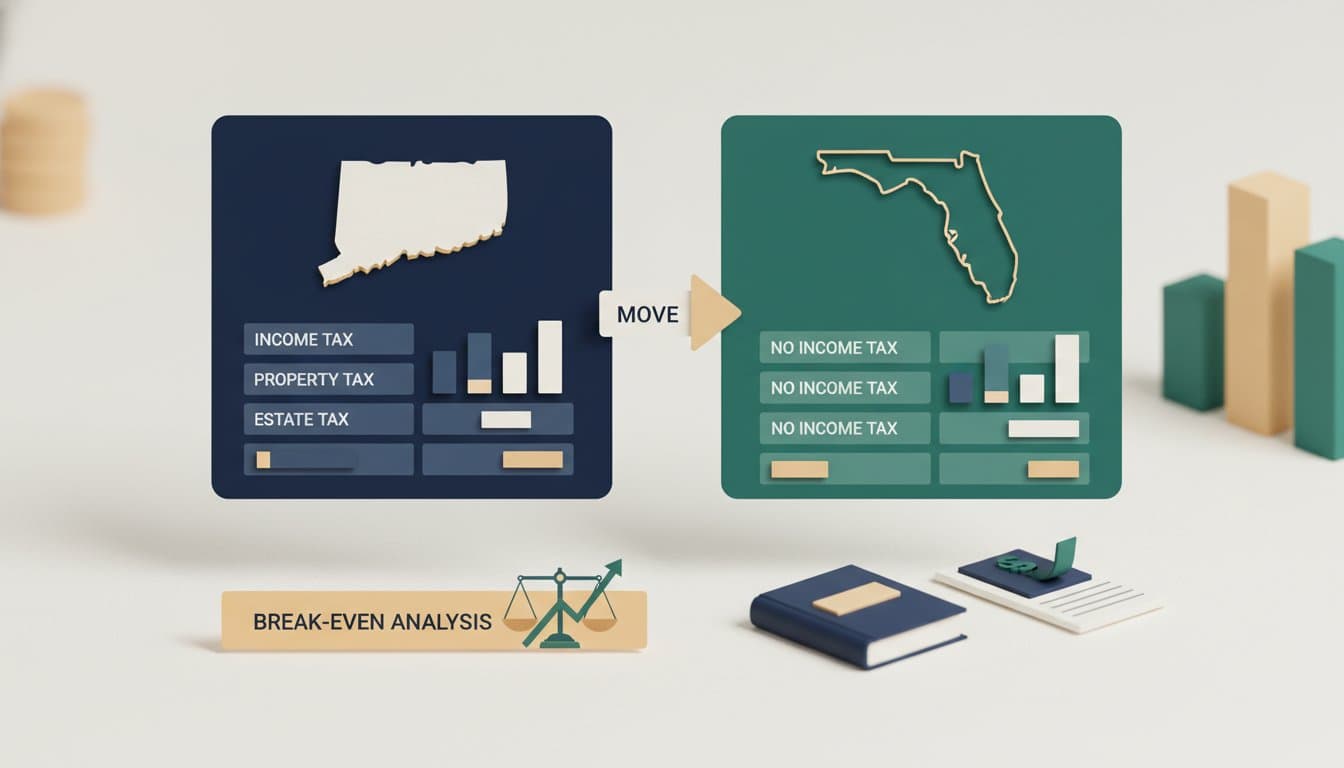
Connecticut vs Florida Tax Structure: What Retirees Actually Pay
The decision to relocate from Connecticut to Florida in retirement comes down to a single question: does the tax savings justify the cost and complexity of the move? For high-net-worth retirees, the answer depends on income level, estate size, and how carefully the transition is executed. A Connecticut vs Florida retiree tax move is a state-by-state comparison of income tax, property tax, and estate tax burdens that determines whether relocating saves or costs you money over the long term.
Connecticut and Florida represent opposite ends of the state tax spectrum for retirees. Connecticut taxes nearly every source of retirement income — Social Security benefits, pension payments, IRA distributions, and 401k withdrawals — at rates up to 6.99% for incomes above $500,000.1 Florida imposes zero state income tax on any retirement income source, making it one of nine states with no personal income tax.2
The difference is not marginal. For a retiree withdrawing $150,000 annually from retirement accounts — a typical scenario for upper-middle-class retirees — Connecticut takes roughly $10,500 in state income tax each year. Florida takes nothing.
Property taxes tell a different story. Connecticut's average effective property tax rate is 1.83% of assessed value, among the highest in the nation.3 Florida's average is 0.89%, though this varies significantly by county.3 A $1 million home in Connecticut carries roughly $18,300 in annual property taxes. The same home in Florida costs about $8,900.4
Estate taxes widen the gap further. Connecticut's estate tax exemption threshold is $13.61 million in 2024, with rates from 7.2% to 12% on amounts above the threshold.5 Florida has no estate or inheritance tax whatsoever.6 For retirees with estates approaching or exceeding the exemption, the potential savings run into hundreds of thousands of dollars.
Connecticut vs Florida Tax Structures for Retirees in 2026
The 2026 tax landscape introduces additional considerations. Connecticut's top marginal income tax rate of 6.99% applies to taxable income above $500,000 for single filers and $1 million for joint filers.1 These thresholds are not indexed for inflation, meaning more retirement income gets pushed into the top bracket each year.
Florida's tax structure remains unchanged — no income tax, no estate tax, no inheritance tax. The state generates revenue primarily through sales tax (6% state rate, plus local options up to 2.5%) and property taxes.2
Consider a hypothetical retiree couple with $2 million in retirement accounts, a $1.5 million home, and annual withdrawals of $180,000. Under Connecticut's tax structure, they pay approximately $12,600 in state income tax on withdrawals, $27,450 in property taxes, and face potential estate tax exposure above the $12.92 million threshold. In Florida, income tax is zero, property taxes on a comparable home run roughly $13,350, and estate tax is zero.
The annual savings exceed $26,000 before accounting for the estate tax benefit.
State Tax Comparison Summary
| Factor | Connecticut | Florida |
|---|---|---|
| State Income Tax Rate | Up to 6.99% | 0% |
| Social Security Tax | Taxed (income limits apply) | Not taxed |
| Estate Tax Exemption (2026) | $13.61 million | No estate tax |
| Average Property Tax Rate | 1.83% | 0.89% |
| IRA/401(k) Withdrawal Tax | Ordinary income | Not taxed |
| Homestead Exemption | None | Up to $75,000 |
How State Income Tax Affects Your Social Security Benefits
Connecticut is one of thirteen states that tax Social Security benefits. For joint filers with federal adjusted gross income above $100,000, up to 50% of Social Security benefits are subject to Connecticut's state income tax.1 For single filers, the threshold is $75,000.
Florida does not tax Social Security benefits at the state level.2 A retiree receiving $40,000 annually in Social Security benefits keeps the full amount.
Consider a Connecticut couple with combined income from Social Security and IRA withdrawals — $40,000 from Social Security and $80,000 from an IRA — who pays roughly $1,400 in state tax on their Social Security benefits each year. Over a 20-year retirement, that amounts to roughly $28,000 in lost income.
For retirees with higher Social Security benefits and larger IRA balances, the gap widens. A single filer receiving $50,000 in Social Security and withdrawing $100,000 from retirement accounts faces Connecticut tax on roughly $25,000 of those benefits, adding $1,750 annually to their tax bill.
Property Tax and Homestead Exemptions: Connecticut vs Florida
Property tax differences between the two states are substantial but nuanced. Connecticut's average effective rate of 1.83% applies to full assessed value, with no homestead exemption for primary residences.3 Municipalities reassess property periodically, and values have risen sharply in Fairfield County.
Florida offers a homestead exemption that reduces assessed value by $50,000 for primary residences, plus a $25,000 exemption for non-school taxes.4 The Save Our Homes amendment caps annual assessment increases at 3% or the Consumer Price Index, whichever is lower. This means a home purchased in Florida for $500,000 might be assessed at $550,000 after ten years, while the same home in Connecticut could be assessed at $700,000 or more.
For a retiree moving from a $1.2 million Connecticut home to a $1.2 million Florida home, the annual property tax difference is approximately $11,000 — $21,960 in Connecticut versus $10,680 in Florida, assuming the Florida homestead exemption applies.
The trade-off: Florida's property insurance costs are significantly higher due to hurricane risk. A typical Florida homeowners policy costs $3,600 to $6,000 annually, compared to $1,200 to $2,400 in Connecticut.7 This partially offsets the property tax savings.
Medicare IRMAA Implications of a Cross-State Move
Medicare's Income-Related Monthly Adjustment Amount (IRMAA) is a federal program, not a state one, but a cross-state move can affect it indirectly. IRMAA surcharges apply when modified adjusted gross income exceeds $206,000 for joint filers in 2026 (single filers: $103,000).8
The connection to a Connecticut vs Florida move: selling a Connecticut home generates capital gains that count toward IRMAA income in the year of sale. A retiree selling a primary residence with gains above the $500,000 exclusion for joint filers triggers IRMAA surcharges two years later.
Suppose a couple sells their Connecticut home for $1.8 million with a basis of $800,000. The $1 million gain exceeds the $500,000 exclusion by $500,000. That $500,000 pushes their MAGI well above the IRMAA threshold, adding $4,700 per person to annual Part B premiums for one year.8
The solution: time the home sale to minimize IRMAA impact. Selling in a year with lower other income, or spreading the move across two tax years, can keep MAGI below the threshold. A retiree who sells in December and closes in January effectively splits the gain across two tax years.
401k and IRA Withdrawal Tax Treatment in Each State
Connecticut taxes traditional IRA and 401k withdrawals as ordinary income at rates up to 6.99%.1 Roth IRA withdrawals are tax-free at the federal level and Connecticut follows this treatment — qualified Roth distributions are not subject to state income tax.
Florida taxes no retirement account withdrawals at the state level, regardless of whether the account is traditional or Roth.2 A retiree withdrawing $200,000 annually from a traditional IRA pays $13,980 in Connecticut state income tax and zero in Florida.
The cumulative effect over retirement is substantial. A retiree with $1.5 million in traditional IRA assets withdrawing $75,000 annually over 20 years pays roughly $105,000 in Connecticut state income tax on those withdrawals. In Florida, that same amount stays in the retiree's pocket.
Required minimum distributions (RMDs) compound the issue. At age 73, RMDs begin at roughly 3.9% of account balances, increasing to over 8% by age 90.1 A retiree with $2 million in traditional IRA assets faces RMDs of $78,000 at age 73, growing to $160,000 by age 90.2 Connecticut taxes every dollar of those RMDs.
Long-Term Care Costs and Estate Planning Considerations
Long-term care costs differ significantly between the two states. Connecticut's average annual cost for a private nursing home room is $175,000, while Florida's average is $132,000.9 A three-year stay in Connecticut costs $525,000 versus $396,000 in Florida — a difference of $129,000.
Estate planning advantages favor Florida more heavily. Connecticut's estate tax applies to estates above $13.61 million in 2026, with rates starting at 7.2% and reaching 12%.5 For a hypothetical estate valued at $15 million, the Connecticut estate tax would be roughly $250,000. Florida has no estate tax, so the full amount passes to heirs.
For retirees with estates below the Connecticut threshold, the estate tax difference is irrelevant. But for those with estates approaching or exceeding $13.61 million, the savings justify the move on estate tax alone.
Florida also offers stronger asset protection for retirement accounts. Florida law exempts IRAs and 401ks from creditor claims without dollar limit, while Connecticut caps IRA protection at $100,000 for bankruptcy purposes.10 For retirees concerned about liability exposure, Florida provides superior protection.
Spousal Benefit Coordination Across State Lines
Social Security spousal benefits are federal and do not change based on state residency. However, the interaction between state income tax and spousal benefits differs between Connecticut and Florida.
A spouse receiving a spousal benefit of, say, $24,000 annually pays no state tax on that benefit in Florida. In Connecticut, that same benefit is partially taxable if combined household income exceeds $100,000 for joint filers.1
The more complex issue involves domicile. If one spouse moves to Florida while the other remains in Connecticut for medical or family reasons, the couple may face a split domicile situation. The spouse in Florida must meet the 183-day residency requirement independently, and the couple must file separate state tax returns.
Suppose a husband moves to Florida in January while his wife stays in Connecticut for six months to sell the family home. The husband must document 183 days of Florida presence, maintain a Florida driver's license, register to vote in Florida, and update his will and trust to Florida law. The wife files a Connecticut resident return for the portion of the year she lived there.
Your Next Step
Run a side-by-side tax projection for your specific situation. Calculate your Connecticut state income tax on expected retirement withdrawals, your property tax based on your home's assessed value, and your potential estate tax exposure. Compare those figures to Florida's zero-income-tax structure and lower property tax rates, then add the cost of Florida homeowners insurance and moving expenses.
If the annual savings exceed $15,000 and you can meet the 183-day domicile requirement, the move likely pays for itself within three to five years. Start by gathering your last three years of Connecticut tax returns and a current property tax bill, then consult a CPA who specializes in multi-state retirement tax planning.
Footnotes
-
https://www.ct.gov/drs/category/individual-income-tax ↩ ↩2 ↩3 ↩4 ↩5 ↩6 ↩7
-
https://smartasset.com/retirement/florida-retirement-taxes ↩ ↩2 ↩3 ↩4 ↩5
-
https://taxfoundation.org/data/all/state/2024-property-tax-across-us/ ↩ ↩2 ↩3 ↩4
-
https://floridarevenue.com/property/Pages/homestead.aspx ↩ ↩2
-
https://portal.ct.gov/DRS/Estate-and-Gift-Tax/Estate-and-Gift-Tax ↩ ↩2 ↩3
-
https://smartasset.com/retirement/florida-retirement-taxes ↩
-
https://www.iii.org/article/background-on-hurricane-and-windstorm-insurance ↩ ↩2
-
https://www.medicare.gov/your-medicare-costs/part-b-costs ↩ ↩2
-
https://www.genworth.com/aging-and-you/finances/cost-of-care.html ↩
-
https://www.irs.gov/retirement-plans/plan-participant-employee/retirement-topics-ira-and-retirement-plan-protection ↩