Why COBRA Doesn't Pause Your Medicare Enrollment Clock
Medicare enrollment after COBRA is the process of signing up for Medicare Part B and Part D after your COBRA continuation coverage ends, and it comes with strict deadlines that can trigger permanent penalties if missed. Many early retirees assume COBRA acts as a safety net that pauses the Medicare enrollment clock, but the rules work differently than most expect.
Under federal law, COBRA coverage is not considered "active employment-based coverage" for Medicare enrollment purposes. This distinction matters because the Medicare enrollment clock starts ticking the moment your employer group health plan ends — not when your COBRA coverage ends.
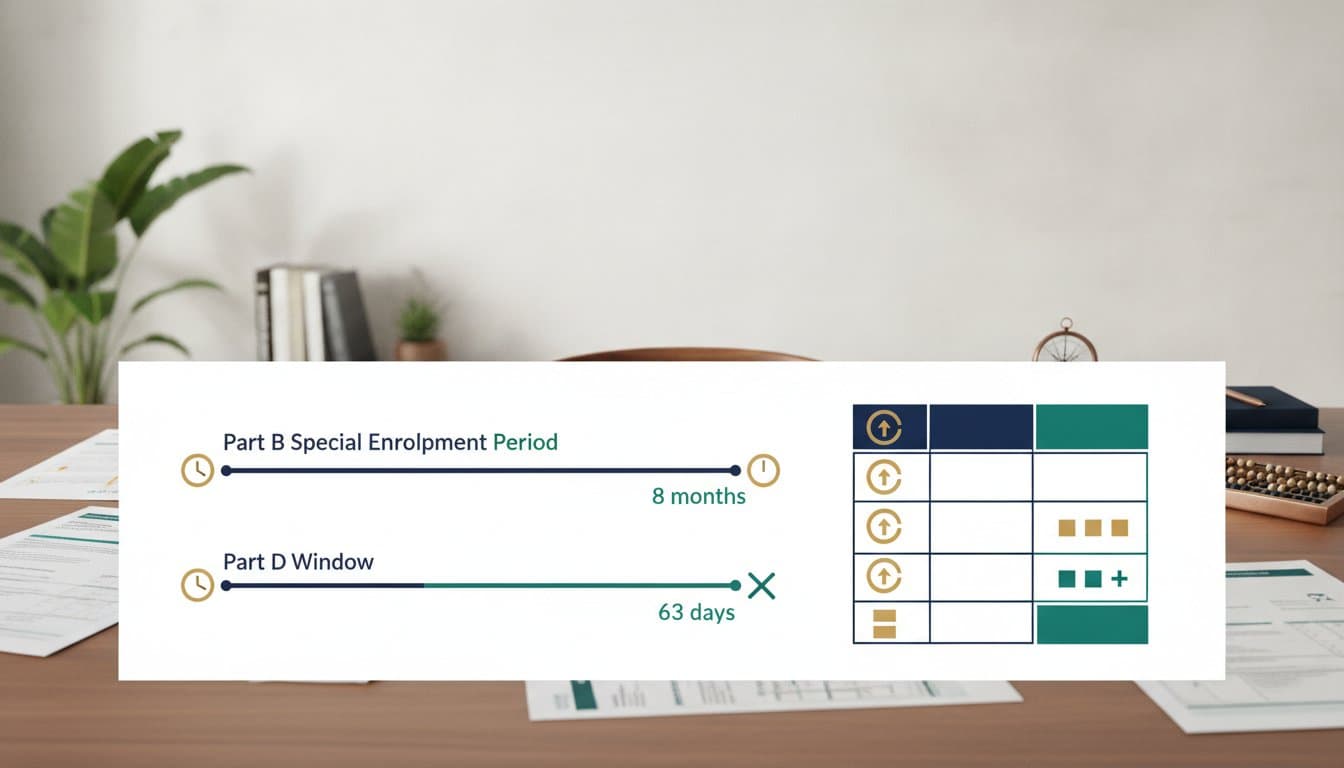
The 8-month Part B Special Enrollment Period (SEP) begins the month after your employment ends or the month after your employer group coverage ends — whichever happens first. If you retired at age 62 and elected 18 months of COBRA, your SEP started when your employer coverage ended, not when COBRA runs out. By month 10 of COBRA, you have already missed the SEP window.
Consider a retiree who left work at 62, took COBRA for 18 months, and turns 65 during month 14 of COBRA. That person's SEP expired at month 8 after employer coverage ended. They are now in penalty territory for Part B without realizing it.
How the Part B Special Enrollment Period Actually Works When COBRA Ends
Medicare enrollment after COBRA includes understanding that the Part B SEP provides an 8-month window to enroll without penalty, but only if you or your spouse had active employment-based coverage at the time of retirement. The SEP begins the month after the employment or the group coverage ends — whichever comes first.
For a retiree who stopped working at 63 and took COBRA, the SEP started when the employer plan ended. COBRA extends your coverage but does not extend your SEP window. By month 9 of COBRA, you have already lost penalty-free Part B enrollment.
The penalty calculation is straightforward but severe. The Part B late enrollment penalty is 10% of the standard premium for each full 12-month period you delayed enrollment without creditable coverage, and this penalty lasts for life. For 2025, the standard Part B premium is $185.00 per month (this is the 2025 figure; 2026 premiums may differ). A two-year delay adds roughly $37.00 per month forever — for example, someone who delays two years pays $222.00 per month instead of $185.00 for the rest of their life.
Calculating Your Part B Late Enrollment Penalty Before It Starts
The penalty formula uses full 12-month periods of delay. Each period adds 10% to the standard Part B premium. The penalty never expires.
| Delay Duration | Penalty Percentage | Monthly Penalty (2025) | Lifetime Cost (20 years) |
|---|---|---|---|
| 12 months | 10% | $18.50 | $4,440 |
| 24 months | 20% | $37.00 | $8,880 |
| 36 months | 30% | $55.50 | $13,320 |
Suppose a retiree delays Part B enrollment for 18 months after their SEP ends. The penalty applies only to the first full 12-month period, adding roughly $18.50 per month for life. A 24-month delay adds approximately $37.00 per month.
The penalty compounds because the base premium increases annually. A 10% penalty on a $200 premium in 2030 costs $20 per month, not $18.50. The lifetime cost grows with each premium increase.
The Part D Creditable Coverage Requirement and 63-Day Rule
The Part D late enrollment penalty applies when you go 63 or more continuous days without creditable drug coverage after your Initial Enrollment Period ends. The penalty is calculated at 1% of the national base beneficiary premium per month of delay.
For 2025, the national base beneficiary premium is $36.78. A 12-month delay adds $4.41 per month to your Part D premium. A 36-month delay adds $13.24 per month.
| Months Without Creditable Coverage | Monthly Penalty (2025) | Lifetime Cost (20 years) |
|---|---|---|
| 63 days to 6 months | $2.21 | $530 |
| 12 months | $4.41 | $1,058 |
| 24 months | $8.82 | $2,117 |
| 36 months | $13.24 | $3,178 |
COBRA prescription drug coverage may or may not be "creditable." CMS requires employers to notify COBRA enrollees in writing whether their drug coverage is creditable for Part D purposes. If you do not receive this notice, request it immediately. Without written confirmation, assume your COBRA drug coverage is not creditable and enroll in Part D within 63 days of COBRA ending.
COBRA-to-Medicare Transition Timeline for Mid-Year Enrollees
Mid-year transitions create the highest risk of missed deadlines because the Medicare enrollment windows do not align with COBRA termination dates.
| Event | Timeline | Action Required |
|---|---|---|
| Employer coverage ends | Month 0 | SEP begins |
| COBRA begins | Month 0 | Request creditable coverage notice |
| SEP ends | Month 8 | Part B enrollment deadline |
| COBRA ends | Month 18 | Part D 63-day clock starts |
| Part D penalty trigger | Month 20 + 63 days | Permanent penalty begins |
For a retiree whose COBRA ends in June, the Part D 63-day window runs through August. Missing that window means a permanent Part D penalty. The Part B SEP, however, may have expired months earlier if the retiree turned 65 during COBRA.
Avoiding the IRMAA Surcharge Trap During Your SEP
The Income-Related Monthly Adjustment Amount (IRMAA) applies when your modified adjusted gross income exceeds certain thresholds. For 2025, the first IRMAA tier begins at $106,000 for single filers and $212,000 for joint filers (these are 2025 thresholds based on 2023 tax returns; 2026 thresholds may differ).
Enrolling in Part B during your SEP triggers an IRMAA determination based on your tax return from two years prior. A retiree who sold a business in 2023 and enrolled in Part B in 2025 would face IRMAA based on the 2023 capital gain income.
The IRMAA appeal process allows you to request a reduction using Form SSA-44 if you experienced a life-changing event such as retirement, reduced work hours, or loss of income. The key is filing the appeal within 60 days of receiving the IRMAA notice.
Step-by-Step: Enrolling in Part B and Part D the Month COBRA Ends
Step 1: Confirm your COBRA end date in writing from your former employer. This date determines both your Part B SEP status and your Part D 63-day window.
Step 2: Determine whether your Part B SEP is still open. If you are within 8 months of your employer coverage ending, you can enroll without penalty. If more than 8 months have passed, you face the Part B late enrollment penalty.
Step 3: Enroll in Part B through Social Security. You can apply online at ssa.gov, by phone, or in person. The effective date depends on when you enroll during the month.
Step 4: Request a creditable coverage notice from your COBRA administrator. If your drug coverage is not creditable, enroll in Part D immediately.
Step 5: Enroll in a Part D plan through Medicare.gov within 63 days of COBRA ending. Use the plan finder tool to compare premiums, deductibles, and formularies.
Step 6: File Form SSA-44 if your income has dropped significantly since the tax year used for IRMAA determination.
Your Next Step
Call Social Security at 1-800-772-1213 or visit ssa.gov to confirm your Part B SEP end date based on when your employer coverage ended, not when COBRA ends. If you are within 8 months of that date, enroll in Part B immediately. If you are past that date, enroll during the next General Enrollment Period and accept the penalty. Simultaneously, request a creditable coverage notice from your COBRA administrator and enroll in a Part D plan within 63 days of COBRA ending.
At Smart Money After 60, we help early retirees navigate Medicare enrollment after COBRA with clarity — these two actions, confirming your SEP status and securing creditable drug coverage, prevent the two most expensive Medicare penalties you could face.