Why Early Retirees Must Choose Between HSA and MSA
The core conflict is simple: you cannot contribute to an HSA after enrolling in any part of Medicare. HSA eligibility ends the month you enroll in Medicare Part A or B.1
This creates a hard deadline for early retirees transitioning from employer coverage. Suppose you turn 62, leave your job, and enroll in COBRA for 18 months. You can keep contributing to your HSA during COBRA because it is not Medicare. But the moment you file for Medicare Part A — even if it is premium-free — your HSA contribution window slams shut permanently.
Medicare MSA plans solve a different problem. They pair a high-deductible health plan with a trustee-directed savings account funded by Medicare itself, not by the account holder.2 The government deposits money into the MSA annually, and you use those funds to pay medical expenses until you hit the deductible.
This is why the "medicare advantage msa vs hsa" decision is really a sequencing decision. Map out exactly when you will enroll in Medicare Part A, how much HSA runway you have left, and whether an MSA plan fills the gap after that window closes.
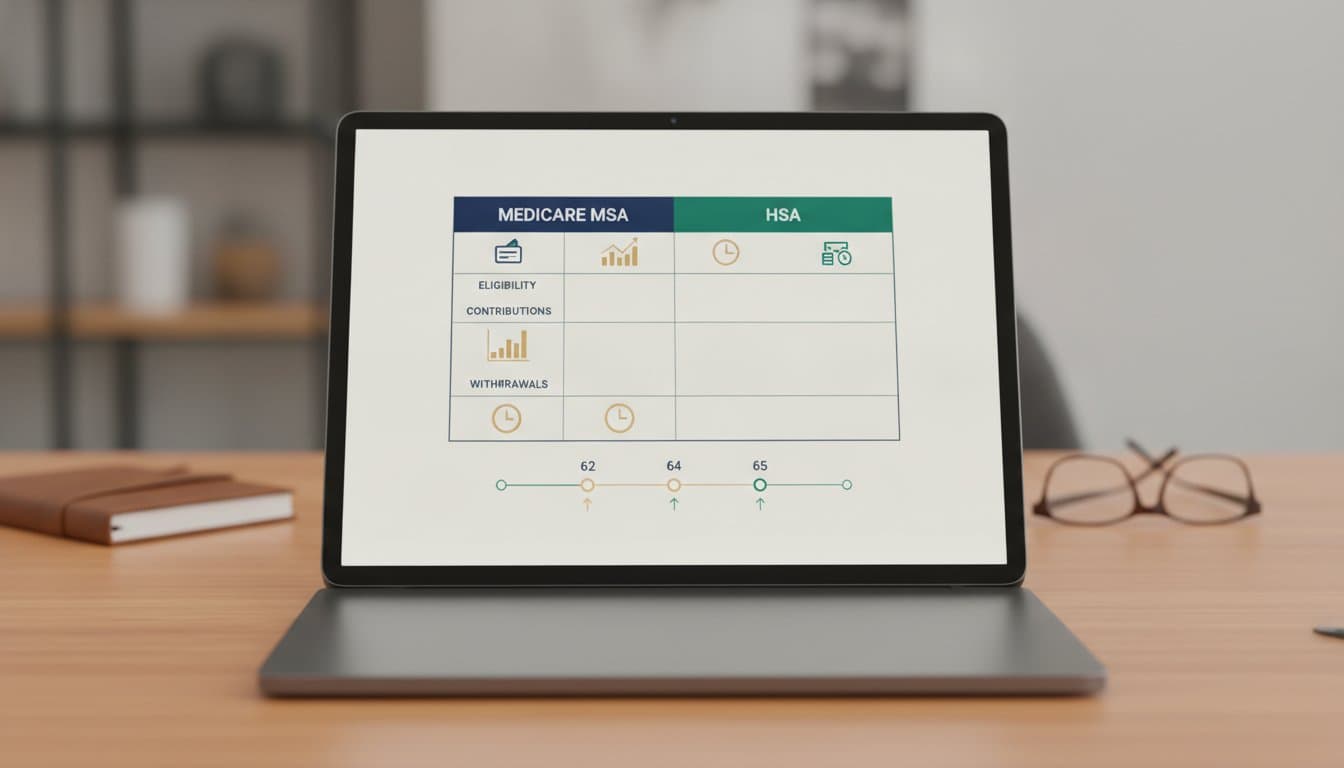
Medicare MSA vs HSA: Key Differences for Early Retirees
The table below shows the structural differences that matter most for early retirees making the transition.
| Feature | HSA | Medicare MSA |
|---|---|---|
| Who contributes | You (pre-tax) and employer | Medicare deposits funds |
| Contribution limit (2025) | $4,300 individual / $8,550 family3 | Varies by plan (set by CMS) |
| Eligibility requirement | Must be enrolled in an HSA-eligible HDHP, not enrolled in Medicare | Must be enrolled in Medicare Part A and Part B |
| Minimum deductible (2025) | $1,650 individual / $3,300 family4 | $2,850 individual5 |
| Maximum out-of-pocket (2025) | $8,3004 | $8,3005 |
| Provider network | Depends on HDHP | No network — any Medicare provider2 |
| Funds roll over | Yes, indefinitely | Yes, indefinitely |
| Tax treatment | Triple tax-advantaged (deduct, grow, withdraw tax-free for qualified expenses) | Medicare deposits are tax-free; withdrawals for qualified expenses are tax-free |
The most important difference is who funds the account. With an HSA, you contribute pre-tax dollars up to the annual limit. With a Medicare MSA, Medicare deposits money into the account — you do not contribute. This means the MSA contribution is not a tax deduction for you, but the deposited funds are not taxable income either.
For an early retiree, the HSA offers more control over contribution amounts and timing. The MSA offers a fixed annual deposit from Medicare that you cannot increase, but also cannot lose.
How HSA Contributions Affect Medicare Enrollment Timing
The rule is absolute: you cannot contribute to an HSA for any month you are enrolled in Medicare Part A, Part B, or both.1 This includes the month you enroll, even if you enroll on the last day.
Consider a hypothetical early retiree, Sarah, who turns 63 in March 2026. She is covered by her former employer's retiree health plan, which is an HSA-eligible HDHP. She wants to delay Medicare Part A enrollment until she turns 65 to keep contributing to her HSA.
Under the special enrollment provision, Sarah can delay Part A without penalty if she has group health coverage based on current employment — either her own or her spouse's.1 But retiree coverage from a former employer does not qualify. If Sarah's plan is a true retiree plan, not a group plan tied to active employment, she cannot delay Part A without facing a late enrollment penalty.
This is where the "medicare part a delay hsa strategy" gets complicated. The IRS looks at whether you have "group health plan coverage based on current employment." Retiree coverage, COBRA, and individual marketplace plans do not qualify. If Sarah's only coverage is retiree-based, she must enroll in Medicare Part A when she turns 65, and her HSA contributions must stop the month she enrolls.
The practical takeaway: if you want to keep contributing to an HSA past age 65, you need either active employer coverage (your own or your spouse's) or a plan that is not Medicare. Once that coverage ends, you have a six-month window to enroll in Part A without penalty, and your HSA contribution window closes.
Using Your HSA to Pay Medicare Premiums Tax-Free
One of the most valuable HSA features for early retirees is the ability to withdraw funds tax-free to pay Medicare premiums. Qualified medical expenses include Medicare Part A, Part B, Part D, and Medicare Advantage premiums.1
This creates a powerful planning opportunity. Suppose you have accumulated $50,000 in your HSA by age 65. You can use those funds to pay your Part B premium (for example, $185 per month for most beneficiaries) and your Part D premium tax-free. Over a 20-year retirement, that could cover roughly $44,400 in Part B premiums alone.2
The key rule: you cannot use HSA funds to pay premiums for a Medicare supplemental policy (Medigap). Medigap premiums are not qualified medical expenses under IRS rules.1 But you can use HSA funds for deductibles, copayments, and coinsurance under any Medicare plan.
For early retirees who delay Social Security to age 70, the HSA becomes a bridge funding tool. You can withdraw HSA funds to pay Medicare premiums during the gap years between 65 and 70, preserving your taxable portfolio for other needs. These withdrawals are tax-free as long as they are used for qualified medical expenses.
Why Medicare MSA Plans Work Best With High Deductibles
Medicare MSA plans are designed for people who expect low to moderate healthcare utilization. The high deductible — $2,850 minimum for individuals in 20255 — means you pay all medical costs out of pocket until you reach that threshold. Medicare deposits a fixed amount into your MSA each year, typically less than the deductible.
If you have a high-cost year, you pay the first $3,000 out of pocket (using the MSA deposit plus your own funds), and then your MSA plan covers all additional costs for the rest of the year with no coinsurance or copayment after the deductible.2
The "medicare msa contribution limits 2026" vary by plan and are set by CMS annually. Unlike an HSA, you cannot choose to contribute more. The deposit amount is fixed by the plan design. This makes MSA plans less flexible for people who want to maximize tax-advantaged savings.
For early retirees with significant HSA balances, the MSA serves as a complementary account. You use your HSA for ongoing medical expenses and let the MSA accumulate as a backup fund for high-cost years.
Coordinating HSA Withdrawals With Social Security Income
Social Security benefits affect your Medicare premiums through the Income-Related Monthly Adjustment Amount (IRMAA). Higher modified adjusted gross income (MAGI) triggers higher Part B and Part D premiums.
HSA withdrawals for qualified medical expenses are tax-free and do not count as income for IRMAA purposes. This is a critical advantage. Suppose you need a significant amount — say, $10,000 — for a medical procedure in a year when your Social Security and pension income already push you near the IRMAA threshold. Taking that amount from your HSA keeps your MAGI lower than taking it from a traditional IRA.
The "hsa msa alternative medicare enrollment" strategy works best when you coordinate withdrawal timing. If you have both an HSA and an MSA, use the MSA deposits first for routine expenses, since those funds are already in the account. Reserve your HSA for larger expenses or years when you need to manage your MAGI.
For early retirees who delay Social Security to age 70, the HSA provides a tax-free income source during the gap years. You can withdraw HSA funds for medical expenses without increasing your taxable income, which keeps your Social Security benefits untaxed and your IRMAA brackets low.
IRMAA Implications of HSA and MSA Account Balances
Neither HSA nor MSA account balances count as income for IRMAA calculations. IRMAA is based on your MAGI from two years prior, not your asset balances.1
This is a common point of confusion. Early retirees sometimes worry that a large HSA balance will trigger higher Medicare premiums. It will not. The IRS looks at your tax return, not your savings account balances.
However, the way you use those accounts can affect IRMAA. If you withdraw HSA funds for non-qualified expenses, the withdrawal is taxable and counts as income. If you take a large distribution from a traditional IRA to pay medical bills instead of using your HSA, that IRA distribution increases your MAGI and could push you into a higher IRMAA bracket.
The "medicare advantage msa eligibility 2026" rules do not consider account balances either. Eligibility is based on Medicare enrollment, not financial need. Any Medicare beneficiary enrolled in Part A and Part B can choose an MSA plan if one is available in their area.
For early retirees managing IRMAA, the optimal strategy is to use HSA funds for medical expenses before tapping taxable accounts. This keeps your MAGI lower and preserves your tax-advantaged savings for future years.
Choosing Between MSA and HSA Based on Your Retirement Timeline
The decision between MSA and HSA depends on your specific retirement timeline and coverage situation.
If you are still working at age 65 with employer coverage that qualifies as "current employment" coverage, you can delay Medicare Part A and keep contributing to your HSA. This is the best scenario for HSA accumulation. You can continue contributing until you retire, then enroll in Medicare and use your HSA for premiums and expenses.
If you retire before 65 with COBRA or retiree coverage, you have a limited HSA contribution window. You can contribute during COBRA, but once COBRA ends, you must enroll in Medicare. At that point, an MSA plan becomes relevant if you want a high-deductible Medicare option with tax-advantaged savings.
If you retire at 62 with no employer coverage, you need individual coverage until 65. You can use an HSA-eligible HDHP on the marketplace and contribute to an HSA during those years. At 65, you transition to Medicare and can choose an MSA plan if available.
The "medicare advantage msa vs hsa" comparison ultimately comes down to timing. The HSA is a contribution vehicle — you fund it during your working years and early retirement. The MSA is a spending vehicle — Medicare funds it during your Medicare years. Most early retirees benefit from using both in sequence.
Your Next Step
Review your current health coverage and determine whether it qualifies as "group health plan coverage based on current employment." If it does, you can delay Medicare Part A and keep contributing to your HSA. If it does not, calculate how many months of HSA contributions you have left before you must enroll in Medicare. Then check whether a Medicare MSA plan is available in your county for the year you turn 65. This three-step sequence — coverage type, contribution runway, MSA availability — determines which account strategy maximizes your tax-advantaged healthcare savings.
Footnotes
-
https://www.mutualofomaha.com/advice/medicare/new-to-medicare/hsa-rules ↩ ↩2 ↩3 ↩4 ↩5 ↩6
-
https://www.medicare.gov/health-drug-plans/health-plans/your-health-plan-options/MSA ↩ ↩2 ↩3 ↩4 ↩5
-
https://support.taxslider.com/hc/en-us/articles/360059486111-Difference-in-HSA-vs-MSA ↩ ↩2
-
https://support.taxslider.com/hc/en-us/articles/360059486111-Difference-in-HSA-vs-MSA ↩ ↩2 ↩3