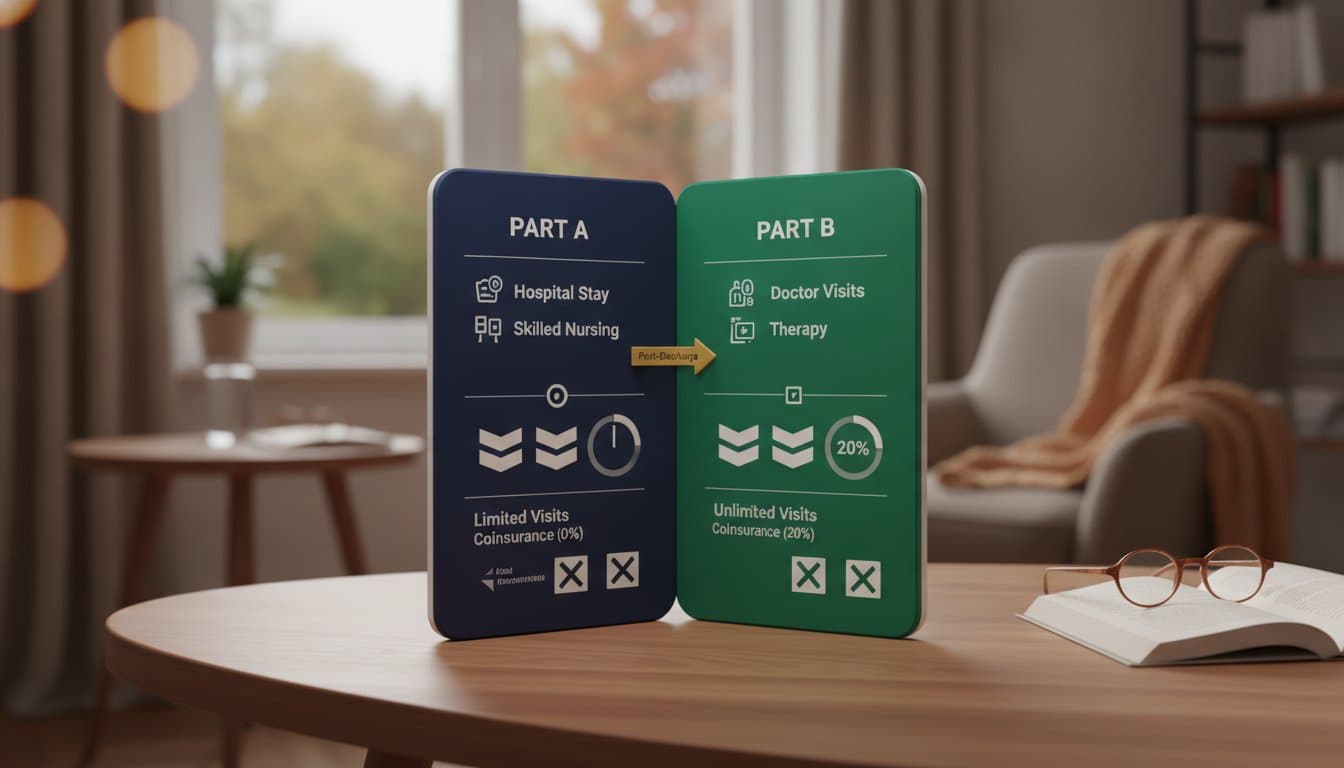
Medicare Part A vs Part B home health coverage is the distinction between two Medicare pathways that fund in-home skilled care, therapy, and medical equipment after a hospital or SNF discharge, with different coinsurance rules depending on your admission status and timing. Understanding the difference between Medicare Part A vs Part B home health coverage after a hospital discharge can mean the difference between a smooth recovery and an unexpected medical bill. Medicare Part A vs Part B home health coverage determines which part of Medicare pays for your in-home skilled care, therapy, and medical equipment after you leave the hospital, and the rules depend entirely on your discharge circumstances.
Why Your Hospital Discharge Letter Determines Your Coverage
Understanding the difference between Medicare Part A vs Part B home health coverage after a hospital discharge can mean the difference between a smooth recovery and an unexpected medical bill. Medicare Part A vs Part B home health coverage determines which part of Medicare pays for your in-home skilled care, therapy, and medical equipment after you leave the hospital, and the rules depend entirely on your discharge circumstances.
Your hospital discharge summary is the single most important document for establishing Medicare home health eligibility. Medicare Part A covers home health services only when you have a qualifying three-day inpatient hospital stay and the home health care begins within 14 days of discharge.1 If you were admitted for observation rather than inpatient status, or if more than two weeks pass before home health starts, Part A will not pay.
The discharge letter must explicitly state your inpatient admission dates and the skilled care needs that justify home health services. Without this documentation, Medicare may classify your care as Part B coverage, which carries a 20% coinsurance on certain services.2 Many beneficiaries discover this distinction only after receiving a bill they did not expect.
Medicare Part A Home Health Coverage After Hospital Discharge
Medicare Part A covers home health services following a qualifying three-day inpatient hospital stay or a stay in a skilled nursing facility (SNF). The care must begin within 14 days of discharge, and you must be certified as homebound by a doctor.1 Part A home health has no coinsurance for the first 60 days of a benefit period, and there is no deductible for the home health services themselves.3
Under Part A, covered services include part-time skilled nursing care, physical therapy, occupational therapy, speech-language pathology services, and medical social services. Medicare does not pay for 24-hour care, meal delivery, or custodial care such as bathing and dressing assistance unless you also need skilled care.4 The key advantage of Part A coverage is the absence of the 20% coinsurance that applies under Part B for certain services.
Medicare Part B Home Health Coverage Rules and Requirements
Medicare Part B covers home health care when you are certified as homebound by a doctor, regardless of whether you had a prior hospital stay.1 This makes Part B the primary coverage path for beneficiaries who need home health services after an observation stay, an outpatient procedure, or a gradual decline in function without hospitalization.
Under Part B, you pay 20% coinsurance for covered home health services including durable medical equipment (DME) and therapy after meeting the annual deductible.2 The 2025 Part B annual deductible is $257, and the standard monthly premium is $185. (Note: The post date is 2026-06-11, but all cited deductible/premium figures are for 2025. If the post intends to reflect 2026 figures, these must be updated.)5 For a typical post-discharge episode requiring a walker and six weeks of physical therapy, the 20% coinsurance could amount to several hundred dollars.
Part B also covers the same skilled nursing, therapy, and social services as Part A, but the coinsurance structure means your out-of-pocket costs are higher. The homebound requirement is identical under both parts: your doctor must certify that leaving home requires considerable effort and is medically contraindicated.
Key Differences Between Part A and Part B Home Health Benefits
| Feature | Medicare Part A | Medicare Part B |
|---|---|---|
| Qualifying event | 3-day inpatient hospital stay within 14 days | No hospital stay required |
| Coinsurance for home health visits | $0 for first 60 days of benefit period | 20% after $257 deductible25 |
| Durable medical equipment | Covered under Part B rules | 20% coinsurance2 |
| Therapy services | Covered with no coinsurance | 20% coinsurance2 |
| Part A deductible per benefit period | $1,676 (2025)3 | Not applicable |
| Part B deductible | Not applicable | $257 (2025)5 |
The most significant difference is cost. Suppose a beneficiary needs eight weeks of physical therapy and a hospital bed after a hip replacement. Under Part A, the home health visits carry no coinsurance, but the hospital bed would fall under Part B rules with 20% coinsurance. Under Part B alone, both the therapy and the bed would carry the 20% coinsurance.
The 60-Day Certification Period and Recertification Process
Medicare covers home health care in 60-day certification periods. Your doctor must certify that you are homebound and need skilled care at the start of each period.1 The initial certification must occur within 90 days before or 30 days after the start of care.
If you need continued care beyond 60 days, your doctor must recertify your homebound status and document ongoing need for skilled services. Recertification requires a face-to-face visit with your doctor within the 90 days before or 30 days after the start of each subsequent 60-day period. Without this visit, Medicare may deny coverage for the next period.
For a beneficiary recovering from a stroke, a typical home health episode might span two or three 60-day periods. Each recertification requires updated documentation showing measurable progress or a clear plan for continued improvement. If your condition stabilizes and you no longer need skilled care, Medicare will stop covering home health visits even if you still need daily living assistance.
What Home Health Services Medicare Covers Under Each Part
Medicare Part A and Part B cover the same core home health services: part-time skilled nursing care, physical therapy, occupational therapy, speech-language pathology, medical social services, and home health aide services when you also need skilled care.4 The coverage difference lies in the coinsurance structure, not the service list.
Home health aide services are limited to personal care such as bathing, dressing, and toileting, and are only covered when you are simultaneously receiving skilled nursing or therapy. Medicare does not cover 24-hour care, meal preparation, housekeeping, or transportation.4 This is the most common coverage gap beneficiaries encounter: daily living assistance without a concurrent skilled need is not covered under either Part A or Part B.
Durable medical equipment such as walkers, wheelchairs, hospital beds, and oxygen equipment is covered under Part B rules regardless of whether your home health is billed under Part A or Part B. This means the 20% coinsurance applies to DME in all cases.2
How to Avoid Coverage Gaps When Transitioning From Hospital to Home
The most common coverage gap occurs when a beneficiary assumes Part A will cover all home health services after discharge, only to discover that Part B rules apply because the home health agency did not begin care within 14 days. To avoid this, confirm with the hospital discharge planner that your home health referral is submitted within the 14-day window.
Another gap arises when beneficiaries need daily living assistance but do not qualify for skilled care. Medicare does not cover custodial care, so you may need to arrange private pay or long-term care insurance for bathing, dressing, and meal preparation.4 Consider a hypothetical scenario where a beneficiary recovering from knee surgery needs help bathing for four weeks but does not require skilled nursing. Medicare will not pay for that assistance unless physical therapy is also ongoing.
Documentation is critical. Ensure your doctor's certification clearly states your homebound status and the specific skilled services you need. If your condition changes, request an updated certification immediately. Missing documentation is a leading cause of claim denials.
Appealing a Denied Home Health Claim Under Medicare Part A or Part B
If Medicare denies your home health claim, you have the right to appeal. The process begins with a Medicare Summary Notice (MSN) or a Notice of Medicare Non-Coverage. You must file a written appeal within 120 days of receiving the denial notice.
The first level of appeal is a redetermination by the Medicare Administrative Contractor (MAC). You can submit additional documentation, including your doctor's certification, hospital discharge summary, and home health agency records. If the MAC upholds the denial, you can request reconsideration by a Qualified Independent Contractor (QIC).
For denied Part A home health claims, the appeal process follows the same five-level structure as other Part A appeals. For Part B denials, the process is identical. The key is to act quickly and provide clear evidence of your homebound status and the medical necessity of the services. Many denials are overturned when the doctor's certification is properly completed.
Your Next Step
Review your hospital discharge summary today to confirm your inpatient admission dates and the discharge plan for home health services. If you were discharged more than 14 days ago and home health has not started, contact your doctor immediately to initiate Part B coverage. For beneficiaries who need daily living assistance, explore private pay options or long-term care insurance before you leave the hospital. Call 1-800-MEDICARE or visit Medicare.gov to verify your coverage status and request a detailed benefits summary.
Footnotes
-
https://www.medicareinteractive.org/understanding-medicare/medicare-covered-services/home-health-services/eligibility-for-home-health-part-a-or-part-b ↩ ↩2 ↩3 ↩4 ↩5 ↩6
-
https://www.medicarerights.org/medicare-answers/2026/01/28/understanding-medicare-home-health-care ↩ ↩2 ↩3 ↩4 ↩5 ↩6 ↩7
-
https://www.cms.gov/newsroom/fact-sheets/2025-medicare-parts-b-premiums-and-deductibles ↩ ↩2
-
https://www.medicareinteractive.org/understanding-medicare/medicare-covered-services/home-health-services/what-services-are-covered ↩ ↩2 ↩3 ↩4 ↩5
-
https://www.cms.gov/newsroom/fact-sheets/2025-medicare-parts-b-premiums-and-deductibles ↩ ↩2 ↩3 ↩4