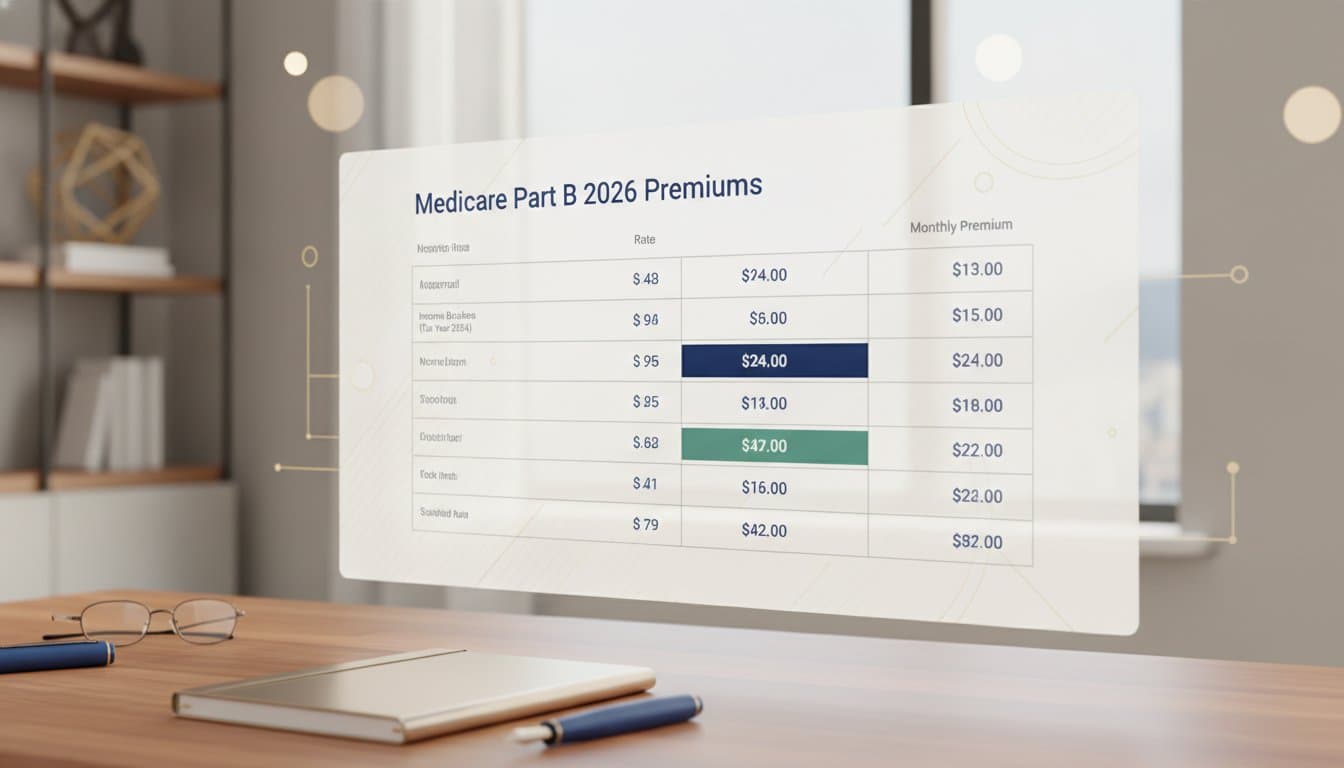
The Medicare Part B premium is the monthly amount beneficiaries pay for outpatient care, physician services, preventive services, and durable medical equipment covered under Medicare Part B. The standard Medicare Part B premium 2026 is projected at $202.90 per month, a 9.7% increase from the 2025 rate of $185, per CMS data. Understanding how these premiums are calculated—and how income-related surcharges can add hundreds to your monthly bill—is essential for anyone planning retirement income or managing withdrawals from tax-deferred accounts.
2026 Medicare Part B Standard Premium Breakdown
The standard Medicare Part B premium 2026 is projected at $202.90 per month, a 9.7% increase from the 2025 rate of $185. Understanding how these premiums are calculated—and how income-related surcharges can add hundreds to your monthly bill—is essential for anyone planning retirement income or managing withdrawals from tax-deferred accounts.
The standard Part B premium covers physician services, outpatient care, preventive services, and durable medical equipment. Most beneficiaries pay this base rate. However, if your 2024 tax return showed MAGI above $106,000 (single) or $212,000 (married filing jointly), you pay an Income-Related Monthly Adjustment Amount (IRMAA) on top of the standard premium.1
IRMAA surcharges range from $74.00 to $395.60 per month, depending on your income tier. These income-related surcharges are determined by a two-year lookback: your 2026 premium is based on your 2024 tax return. Understanding this timing is critical for anyone who had a high-income year recently or is planning major financial moves.
2026 Medicare Part B Standard Premium and Deductible
| Item | 2025 Rate | 2026 Rate | Change |
|---|---|---|---|
| Standard monthly premium | $185.00 | $202.90 | +$17.90 (+9.7%) |
| Annual deductible | $257 | $257 | $0 (0%) |
The annual Part B deductible is $257 for 2026, unchanged from 2025—the first time in several years the deductible has not increased.2 This deductible applies to all services covered under Part B, resetting each calendar year on January 1.
After meeting this deductible, Medicare covers 80% of approved services. You are responsible for the remaining 20% coinsurance with no annual out-of-pocket cap under Original Medicare.3 For example, an outpatient procedure in February 2026 costing $3,000 means you pay the first $257, then Medicare covers 80% of the remaining $2,743 ($2,194.40), leaving you with a $548.60 coinsurance payment.
This 20% coinsurance has no annual limit. A single hospital outpatient visit or surgery can generate thousands in out-of-pocket costs. Many beneficiaries pair Part B with a Medigap policy or Medicare Advantage plan to cap this exposure.
IRMAA Income Tiers and Surcharge Amounts for 2026
IRMAA surcharges apply to beneficiaries whose 2024 MAGI exceeds specific thresholds. CMS publishes five income tiers for 2026, each with a corresponding monthly surcharge added to the $202.90 standard premium.1
| 2024 MAGI (Single) | 2024 MAGI (Married Filing Jointly) | Monthly IRMAA Surcharge | Total Monthly Premium |
|---|---|---|---|
| $106,000 or less | $212,000 or less | $0.00 | $202.90 |
| $106,001–$133,000 | $212,001–$266,000 | $74.00 | $276.90 |
| $133,001–$167,000 | $266,001–$334,000 | $185.20 | $388.10 |
| $167,001–$200,000 | $334,001–$400,000 | $296.40 | $499.30 |
| $200,001–$499,999 | $400,001–$749,999 | $395.60 | $598.50 |
| $500,000+ | $750,000+ | $395.60 | $628.90 |
The highest tier—MAGI of $500,000+ (single) or $750,000+ (married)—pays the maximum Part B premium of $628.90 per month.3
Consider a married couple with 2024 MAGI of $275,000. They fall into the third tier, paying approximately $185 per person per month in IRMAA surcharges.4 That's over $4,400 per year in additional premiums for the couple—a significant expense that could have been avoided with strategic income planning.
How the Two-Year Lookback Determines Your Premium
Medicare uses a two-year lookback to determine your Part B premium. Your 2026 premium is based on your 2024 tax return—specifically, your MAGI as reported on line 11 of IRS Form 1040.5 This means a one-time event in 2024, such as a large capital gain from selling a business or a Roth conversion, can trigger IRMAA surcharges two years later.
MAGI for IRMAA purposes includes adjusted gross income plus tax-exempt interest income. Common income sources that count toward the threshold include wages, self-employment income, Social Security benefits (taxable portion), pension distributions, IRA and 401(k) withdrawals, capital gains, rental income, and tax-exempt interest from municipal bonds.
The lookback creates a planning opportunity. If you anticipate a high-income year in 2024, you can estimate your 2026 IRMAA tier and adjust your withdrawal strategy accordingly. For instance, if you're considering a Roth conversion in 2024, calculate whether the conversion pushes your MAGI above $106,000 (single) or $212,000 (married) and whether the resulting IRMAA surcharge outweighs the long-term tax benefit.
Qualifying Life Events That Trigger an IRMAA Appeal
The Social Security Administration allows IRMAA appeals when a beneficiary experiences a qualifying life event that reduces their income after the lookback year.5 These events include retirement or reduction in work hours, divorce or annulment, death of a spouse, loss of pension income, loss of income-producing property due to disaster or theft, and employer settlement payments that cease.
If you retired in 2025 but your 2024 income was high due to your final year of full-time work, you can file an IRMAA appeal using your current, lower income. The key is that the life event must have caused a major life-changing event that materially reduced your income.
For example, imagine you retired in June 2025 at age 66. Your 2024 MAGI was $150,000 due to your final full year of salary and bonuses.6 Under the two-year lookback, your 2026 Part B premium would be $388.10 per month (tier 3).1 However, your 2025 income—after retirement—is only $85,000 from Social Security and a small pension.5 You qualify for an IRMAA reduction based on the retirement life event.
Filing SSA-44: Step-by-Step IRMAA Reduction Request
The SSA-44 form is the official request for an IRMAA reduction based on a qualifying life event.5 Here is the process:
-
Download SSA-44 from the Social Security Administration website. The form asks for your Medicare claim number, the life event type, and your estimated current-year income.
-
Complete Part A with your personal information and Medicare number.
-
Complete Part B by checking the box for your qualifying life event (retirement, divorce, death of spouse, etc.) and entering the date the event occurred.
-
Complete Part C with your estimated MAGI for the current year (2026) and the following year (2027). You must provide a reasonable estimate based on your current income sources.
-
Attach supporting documentation—a retirement letter from your employer, divorce decree, death certificate, or pension termination notice. Without documentation, SSA will not process the appeal.
-
Submit to your local SSA office by mail, fax, or in person. Processing typically takes 30–60 days.
If approved, SSA reduces your IRMAA surcharge to the tier matching your current income. The reduction is retroactive to January 1 of the year you filed, so you receive a refund for any overpaid premiums.
A common mistake is filing SSA-44 too early. You must wait until the life event actually occurs—you cannot file based on a planned retirement date. File the form after your last day of work, not before.
Coordinating Social Security and Medicare Withdrawals
Social Security benefits are often deducted directly from Part B premiums, creating a natural coordination point. The Social Security COLA for 2026 partially offsets the Part B premium increase, though the exact COLA percentage is determined by the Bureau of Labor Statistics CPI-W data.4
For beneficiaries whose Part B premium exceeds their monthly Social Security benefit, Medicare bills them directly through the Medicare Easy Pay system or quarterly invoices. This situation typically affects high-income beneficiaries with large IRMAA surcharges or those who delayed Social Security past age 70.
Consider a beneficiary with a monthly Social Security benefit of $1,800 and a total Part B premium of $388.10 (tier 3). Medicare deducts the premium from the benefit, leaving a net payment of $1,411.90.6 If the same beneficiary had a $628.90 premium (maximum tier), the deduction would leave only $1,171.10—a significant reduction in disposable income.
Strategic timing of Social Security claiming can help manage IRMAA exposure. If you delay Social Security until age 70, your benefit increases by 8% per year past full retirement age. However, those additional years of higher income from other sources may push you into a higher IRMAA tier when Part B premiums are calculated.
Strategic Roth Conversions to Manage Future IRMAA Tiers
Roth conversions offer a powerful tool for managing future IRMAA tiers, but timing is critical. A Roth conversion in 2024 increases your 2024 MAGI, which determines your 2026 Part B premium. If the conversion pushes you into a higher IRMAA tier, the surcharge applies for the entire year—not just the month of the conversion.
The strategy works best when you plan conversions in years when your income is naturally low, such as between retirement and the start of Social Security or Required Minimum Distributions (RMDs). For example, suppose you retire at 63 and begin Social Security at 67. The four-year gap (ages 63–66) is an ideal window for Roth conversions at lower marginal tax rates and without IRMAA consequences.
However, you must account for the two-year lookback. A Roth conversion in 2024 affects your 2026 Part B premium. If you convert $50,000 in 2024, your MAGI increases by $50,000, potentially pushing you from the standard premium tier into tier 2 or 3 for 2026. The additional IRMAA cost is roughly $888–$2,222.40 in total annual surcharges.7
The Qualified Charitable Distribution (QCD) is another tool. Beneficiaries age 70½ or older can transfer up to $105,000 per year directly from an IRA to a qualified charity.8 QCDs count toward RMD requirements but do not increase MAGI, making them IRMAA-neutral. For a beneficiary with a $30,000 RMD, directing the full amount to a QCD keeps that $30,000 out of MAGI, potentially preserving a lower IRMAA tier.
Your Next Step
Review your 2024 tax return to determine your MAGI and estimate your 2026 Part B premium tier. If your MAGI exceeds $106,000 (single) or $212,000 (married filing jointly), calculate the total annual IRMAA surcharge you will pay. Then, identify any qualifying life events from 2025 or 2026 that could support an SSA-44 appeal. Download the form, gather supporting documentation, and submit it to your local SSA office before March 31, 2026, to ensure any reduction applies for the full year. For those still working or planning Roth conversions, model the two-year lookback effect before making withdrawal decisions—a $10,000 conversion today could cost you $888 in IRMAA surcharges two years from now.
Footnotes
-
https://unitedmedicareadvisors.com/blog/medicare/2026-medicare-part-b-premium ↩ ↩2 ↩3 ↩4 ↩5
-
https://unitedmedicareadvisors.com/blog/medicare/2026-medicare-part-b-premium ↩ ↩2
-
https://www.currentfederaltaxdevelopments.com/blog/2025/11/17/2026-adjustments-to-medicare-parts-a-b-and-d-a-technical-review-of-premiums-and-irmaa-calculations ↩ ↩2
-
https://www.moaa.org/content/publications-and-media/news-articles/2025-news-articles/health-care-and-earned-benefits/how-much-will-your-medicare-part-b-premium-rise-in-2026 ↩ ↩2 ↩3 ↩4 ↩5 ↩6
-
https://www.rrb.gov/Newsroom/NewsReleases/MedicarePartBPremium ↩ ↩2 ↩3
-
https://www.cms.gov/newsroom/fact-sheets/2026-medicare-parts-b-premiums-deductibles ↩
-
https://www.cms.gov/newsroom/fact-sheets/2026-medicare-parts-b-premiums-deductibles ↩ ↩2