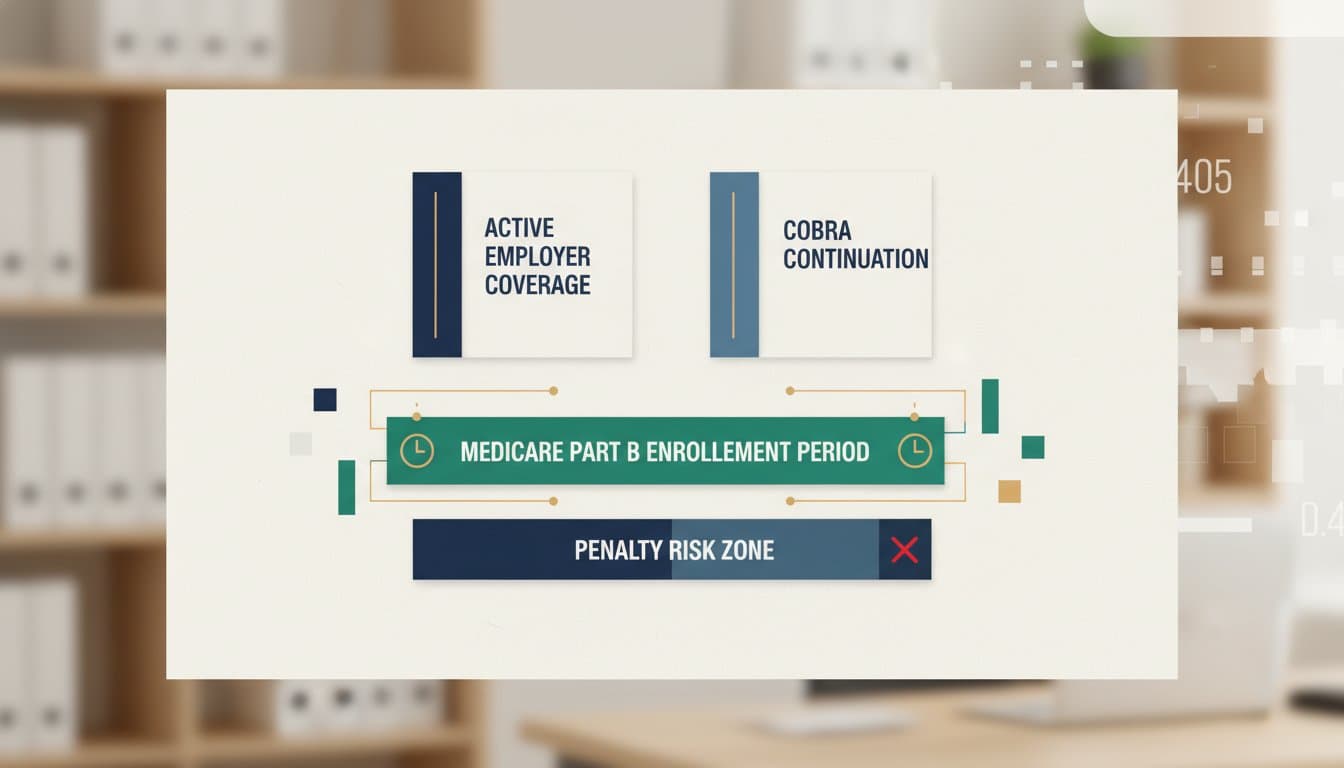
Why COBRA Is Not Creditable Coverage for Medicare Part B
Medicare Part B and COBRA creditable coverage is a distinction that determines whether you face a permanent late enrollment penalty. COBRA continuation coverage does not qualify as creditable coverage for Medicare Part B, meaning the clock on your enrollment window starts ticking when your employer coverage ends, not when your COBRA ends.
The Centers for Medicare & Medicaid Services defines creditable coverage for Part B differently than for Part D prescription drug plans. For Part B, only coverage under an active group health plan based on current employment qualifies as creditable.1 COBRA is continuation of that coverage, not active employment-based coverage.
The Social Security Act explicitly treats COBRA as a gap-filler, not a substitute for employer-sponsored insurance. When you leave a job at age 64 or older, your employer coverage ends on your termination date. COBRA extends the same health plan for up to 18 months, but Medicare considers that extension a separate arrangement.2
This distinction matters because the 8-month Special Enrollment Period for Part B begins the month your employer coverage ends, not the month your COBRA ends. If you enroll in COBRA thinking it preserves your Part B enrollment rights, you may miss the SEP window entirely.
What COBRA Covers and What It Misses for Medicare
COBRA covers the same medical, hospital, and prescription drug benefits your employer plan provided. It does not cover Medicare Part B outpatient services, Part A hospital insurance, or Medigap supplemental policies. COBRA also does not include the late enrollment penalty protections that active group health plans provide.
For a retiree turning 65 while on COBRA, the gap is significant. Suppose you terminate employment in January at age 64 and elect 18 months of COBRA. Your employer coverage ends in January. The 8-month SEP for Part B runs from January through August. If you wait until your COBRA ends in July of the following year to enroll in Part B, you have already missed the SEP by 8 months.3
COBRA also does not coordinate with Medicare as primary payer. Once you enroll in Medicare, COBRA becomes secondary insurance. This changes how claims are paid and may leave you with higher out-of-pocket costs if you delay Part B enrollment.
How Medicare Defines Creditable Coverage for Part B
Medicare defines creditable coverage for Part B as coverage under a group health plan based on current employment of the individual or their spouse.1 The key distinction is "current employment." If you are working for an employer with 20 or more employees, that employer's group health plan is creditable coverage for Part B. Once you separate from employment, even if you continue the same plan through COBRA, it no longer meets the "current employment" test.
This rule applies regardless of your age. A 66-year-old who retires and elects COBRA must still enroll in Part B within 8 months of the employment termination date, not the COBRA end date. The only exception is if you or your spouse continues working and maintains active group health coverage.
The Penalty Risk of Relying on COBRA Past Age 65
The Part B late enrollment penalty is 10% of the standard premium for each full 12-month period you could have enrolled but did not.4 This penalty applies for the entire time you have Part B, with no cap.
Consider a retiree who delays Part B enrollment for 24 months while on COBRA, believing COBRA protects them. The penalty would be 20% added to the Part B premium.5 In 2025, the standard Part B premium is $185 per month.6 With a 20% penalty, that retiree pays $222 per month instead of $185 — an extra $37 per month, or $444 per year, for life.
For a retiree who delays enrollment for 36 months, the penalty is 30%.5 That same $185 premium becomes $240.50 per month. Over a 20-year retirement, the extra cost exceeds $13,000.7
The penalty compounds because it is calculated as a percentage of the standard premium, which increases most years. A penalty that starts at roughly $37 per month in 2025 grows as premiums rise.
Comparing COBRA Costs Against Medicare Part B Premiums
COBRA premiums are typically higher than Medicare Part B premiums because you pay the full group rate plus a 2% administrative fee. For a retiree leaving a job with a $600 per month employer contribution, COBRA might cost $800 to $1,200 per month for individual coverage.
| Coverage Option | Typical Monthly Cost (2025) | Coverage Duration |
|---|---|---|
| COBRA (individual) | $600 – $1,200 | Up to 18 months |
| Medicare Part B | $1856 | Lifetime |
| Medicare Part D (standalone) | $35 – $80 | Annual renewal |
| Medigap Plan G | $120 – $250 | Lifetime |
For a retiree age 65, enrolling in Part B at $185 per month plus a Part D plan at roughly $50 per month and a Medigap policy at approximately $180 per month totals about $415 per month. COBRA alone may cost $800 or more, and it does not provide the same coverage as Medicare.
The cost comparison becomes more favorable to Medicare when you factor in the late enrollment penalty. For example, delaying Part B enrollment to save $185 per month for 18 months saves $3,330 in the short term but triggers a penalty that costs more over time.
Timing Your Part B Enrollment After COBRA Ends
The 8-month SEP for Part B begins the month after your employer coverage ends, not the month after your COBRA ends.5 If you elect COBRA, you must enroll in Part B within that 8-month window or wait until the General Enrollment Period (January 1 through March 31 each year), with Part B coverage starting July 1.
For example, suppose you terminate employment on March 15, 2025. Your employer coverage ends March 31, 2025. The 8-month SEP runs from April 1, 2025 through November 30, 2025. If you elect 18 months of COBRA through September 2026, you must still enroll in Part B by November 30, 2025.
If you miss the SEP, you cannot enroll in Part B until the next General Enrollment Period. Coverage would start July 1, 2026, and you would owe a late enrollment penalty for the period from December 2025 through June 2026.
Special Enrollment Period Rules for COBRA Beneficiaries
The SEP for Part B after employer coverage ends is available to individuals who were covered under a group health plan based on current employment.5 The SEP lasts 8 months from the month employer coverage ends.
COBRA beneficiaries qualify for this SEP only if they enroll in Part B within the 8-month window. Once that window closes, the SEP is no longer available, and the individual must use the General Enrollment Period.
The SEP also applies to dependents who lose employer coverage through a qualifying event such as termination, divorce, or loss of dependent status.7 Dependents face the same 8-month deadline and the same penalty risk if they rely on COBRA.
For individuals who are already enrolled in Part A when they lose employer coverage, the SEP for Part B is the same 8-month period. Part A enrollment does not extend the SEP or change the deadline.
Coordinating COBRA With Medicare and a Health Savings Account
Once you enroll in Medicare Part A, you can no longer contribute to a Health Savings Account (HSA). If you have an HSA and are considering COBRA, you must stop HSA contributions at least six months before applying for Medicare to avoid tax penalties.
For a retiree who turns 65 while on COBRA, the coordination is complex. Suppose you have an HSA with a $5,000 balance and continue COBRA for 18 months after retirement at age 64. You cannot contribute to the HSA after you enroll in Medicare at age 65, but you can use the existing HSA funds tax-free for qualified medical expenses, including Medicare premiums.
COBRA and Medicare can run concurrently, but Medicare becomes primary payer once you enroll. This means COBRA pays secondary benefits, which may reduce your out-of-pocket costs but does not eliminate the need for Part B enrollment.
Your Next Step
Review your employment termination date and calculate the 8-month SEP deadline for Medicare Part B enrollment. If you are within that window, complete the CMS-40B application for Part B online or at your local Social Security office. If you are approaching the deadline, do not wait — submit your application before the 8-month mark to avoid a lifetime late enrollment penalty. For personalized guidance, consult a Medicare specialist who can review your specific COBRA end date and enrollment timeline.
Footnotes
-
https://medicareadvocacy.org/people-with-medicare-beware-cobra-is-not-coverage-as-a-current-employee ↩ ↩2 ↩3
-
https://medicareschool.com/learning-center/how-to-avoid-mistakes-with-cobra-and-medicare ↩
-
https://peakinsuranceadvisors.com/cobra-is-not-creditable-coverage-for-medicare-part-b ↩ ↩2
-
https://www.cms.gov/Medicare/Eligibility-and-Enrollment/MedicareMangCareEligEnrol/Downloads/SEPIO102011508pdf.pdf ↩ ↩2 ↩3 ↩4 ↩5
-
https://www.cms.gov/newsroom/fact-sheets/2025-medicare-parts-b-premiums-and-deductibles ↩ ↩2
-
https://www.cms.gov/Medicare/Eligibility-and-Enrollment/MedicareMangCareEligEnrol/Downloads/SEPIO102011508pdf.pdf ↩ ↩2