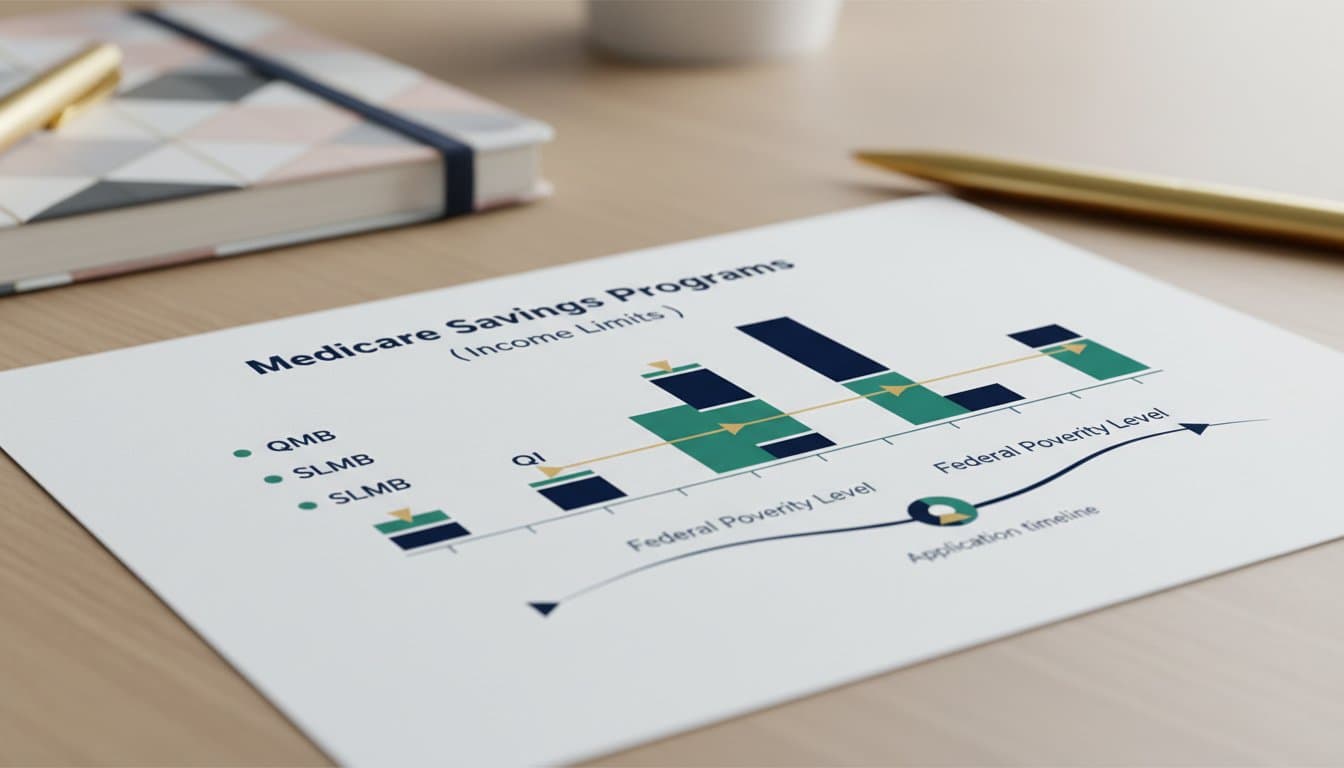
Medicare Savings Programs are state-administered assistance programs funded jointly by federal and state governments that help eligible retirees cover Medicare Part B premiums, deductibles, and copays.1 For readers of Smart Money After 60, understanding these programs is essential because eligibility depends on your income and assets, with four program levels (QMB, SLMB, QI, QDWI) offering different benefits. This guide explains the updated income limits and how to apply. Updated for 2026.
What Medicare Savings Programs Cover and Why They Matter for Retirees
Medicare Savings Programs 2026 help retirees on fixed incomes cover Part B premiums, deductibles, and copays. For readers of Smart Money After 60, understanding these programs is essential because eligibility depends on your income and assets, with four program levels (QMB, SLMB, QI, QDWI) offering different benefits. This guide explains the updated income limits and how to apply. Updated for 2026.
Medicare Savings Programs cover specific out-of-pocket costs depending on which tier you qualify for. The Qualified Medicare Beneficiary (QMB) program is the most comprehensive — it pays Part A and Part B premiums, deductibles, and coinsurance.1 The Specified Low-Income Medicare Beneficiary (SLMB) program covers only the Part B premium, while the Qualifying Individual (QI-1) program also covers Part B premiums but operates on a first-come, first-served basis with limited federal funding.1
For a retiree paying the standard Part B premium of approximately $185 per month in 2026, SLMB or QI-1 enrollment saves roughly $2,220 per year.1 QMB enrollment saves that amount plus additional costs from deductibles and coinsurance, which can easily reach several thousand dollars annually for someone with regular doctor visits or prescription needs.
The Qualified Disabled and Working Individuals (QDWI) program is a fourth option, but it applies only to disabled beneficiaries under 65 who have returned to work and lost their premium-free Part A.1 For most retirees over 60, QMB, SLMB, and QI-1 are the relevant programs.
2026 QMB Income Limits and Eligibility Requirements
The 2026 federal income limit for QMB eligibility is approximately $1,325 per month for a single applicant and $1,798 per month for a married couple.1 These figures are based on 100% of the Federal Poverty Level (FPL). Eligibility uses Modified Adjusted Gross Income (MAGI), which includes most taxable income sources plus tax-exempt interest and Social Security benefits.2
There is no federal asset or resource test for Medicare Savings Programs, which is a critical distinction from Medicaid.3 A retiree with $200,000 in savings and a home worth $400,000 can still qualify for QMB if their monthly income falls below the threshold. However, some states impose their own resource limits, so checking state-specific rules is essential.
Consider a hypothetical retiree named Sarah who receives $1,400 per month from Social Security and has $200 in monthly pension income. Her total MAGI of $1,600 exceeds the single QMB limit of $1,325.1 She would not qualify for QMB but might qualify for SLMB, which has a higher income threshold.
| Program | Income Limit (Single, 2026) | Income Limit (Married, 2026) | What It Covers |
|---|---|---|---|
| QMB | ~$1,325/month1 | ~$1,798/month1 | Part A/B premiums, deductibles, coinsurance |
| SLMB | ~$1,583/month1 | ~$2,146/month1 | Part B premium only |
| QI-1 | ~$1,583/month1 | ~$2,146/month1 | Part B premium only (limited funding) |
SLMB and QI-1: Who Qualifies for Partial Premium Assistance
SLMB and QI-1 share the same income limits — approximately $1,583 per month for single applicants and $2,146 per month for married couples in 2026, which is 120% of the FPL.1 The difference lies in funding and enrollment structure. SLMB is an entitlement program: anyone who meets the income requirements can enroll. QI-1 has capped federal funding, and states distribute it on a first-come, first-served basis.1
For a retiree whose income falls between 100% and 120% of the FPL, SLMB or QI-1 covers the full Part B premium.1 Suppose a retiree named Michael has $1,500 per month in Social Security income and no other earnings. His income exceeds the QMB limit but falls under the SLMB limit. He qualifies for SLMB and saves approximately $185 per month on his Part B premium.1
QI-1 recipients must reapply each year, and enrollment priority goes to those who qualified in the previous year.1 If funding runs out in a given state, new applicants may be placed on a waiting list. Retirees should apply for QI-1 as early as possible in the year, ideally during the fall open enrollment period.
State Medicare Savings Programs: Expanded Eligibility Rules to Know
While federal guidelines set minimum income thresholds, states have the authority to expand eligibility beyond those limits. As of January 2026, Florida changed how household size is calculated for MSP eligibility, resulting in more applicants qualifying.3 Under the new rule, Florida counts all household members when determining family size, which can lower the per-person income calculation and bring more retirees under the threshold.
Other states have taken different approaches. New York and California have eliminated asset tests entirely for MSPs, while states like Texas and Ohio follow federal guidelines without expansion.2 Some states also offer a "Medicare Savings Program buy-in" that automatically enrolls qualifying beneficiaries without requiring a separate application.
| State | Expansion Feature | Effective Date |
|---|---|---|
| Florida | Expanded household size calculation3 | January 2026 |
| New York | No asset test for MSPs2 | Ongoing |
| California | No asset test for MSPs2 | Ongoing |
Retirees should contact their State Health Insurance Assistance Program (SHIP) for state-specific eligibility rules. SHIP counselors provide free, unbiased guidance and can help determine whether a state's expanded rules apply.1
How to Apply for Medicare Savings Programs Step by Step
Applying for MSPs requires submitting an application through your state's Medicaid agency or Department of Social Services. The process varies by state, but the general steps are consistent.
First, gather documentation: proof of income (Social Security award letter, pension statements, tax returns), proof of residency (utility bill, lease agreement), and proof of citizenship or lawful presence (birth certificate, passport). Second, complete the state-specific MSP application form, which is often the same form used for Medicaid applications. Third, submit the application online, by mail, or in person at your local social services office.
Most states process MSP applications within 30 to 45 days. If approved, coverage is typically retroactive to the first day of the month in which you applied. For example, if you apply on March 15 and are approved, your Part B premium assistance begins March 1.
The Social Security Administration does not process MSP applications directly, but it can provide income verification documents needed for the application. SHIP counselors can help retirees complete the paperwork and identify any missing documentation before submission.1
Common MSP Application Mistakes and How to Avoid Them
The most common MSP application mistake is misunderstanding the income calculation. MSPs use MAGI, which includes Social Security benefits, pension income, IRA distributions, and tax-exempt interest. A retiree who reports only their Social Security income but omits a small pension or part-time job earnings may be denied for underreporting.
Another frequent error is failing to reapply for QI-1 annually. Unlike QMB and SLMB, which remain in effect until income changes, QI-1 requires a new application each year. Retirees who assume their coverage continues automatically may lose their Part B premium assistance mid-year.
A third mistake is ignoring state-specific asset tests. While there is no federal asset test for MSPs, some states impose resource limits. For instance, a retiree with significant savings who qualifies under federal income rules might be denied in a state with a $10,000 resource limit. Checking state rules before applying prevents wasted effort.
Finally, many retirees miss the opportunity to apply for retroactive coverage. If you incurred Part B premium costs in the months before applying, you may be eligible for reimbursement. Always ask your state agency about retroactive eligibility when submitting your application.
Medicare Savings Programs vs. Medicaid: Key Differences for Retirees
Medicare Savings Programs and Medicaid serve different purposes, though they share application processes in many states. MSPs are specifically designed to help Medicare beneficiaries pay for Medicare-related costs. Medicaid provides comprehensive health coverage, including long-term care, for low-income individuals of all ages.
The eligibility criteria differ significantly. MSPs use income limits based on the FPL and generally have no asset test at the federal level. Medicaid has both income and asset limits, which vary by state but are typically much stricter. A retiree with $50,000 in savings might qualify for an MSP but be ineligible for Medicaid.
| Feature | Medicare Savings Programs | Medicaid |
|---|---|---|
| Purpose | Covers Medicare costs | Comprehensive health coverage |
| Income limit (single, 2026) | Up to 120% FPL (~$1,583/month)1 | Varies by state, typically lower |
| Asset test | None at federal level3 | Yes, varies by state |
| Long-term care coverage | No | Yes |
For retirees who qualify for both programs — known as "dual eligibles" — Medicare pays first, and Medicaid covers remaining costs, including Part B premiums, deductibles, and prescription drug costs. Dual eligibles also receive the Low-Income Subsidy (LIS) for Part D, which has an individual income cap of approximately $1,350 per month and a resource limit of $9,950 for 2026.4
Your Next Step
For Smart Money After 60 readers, the next action is clear: contact your State Health Insurance Assistance Program (SHIP) for a free, unbiased eligibility review. SHIP counselors can help you determine which Medicare Savings Program you qualify for, gather the required documentation, and submit your application correctly the first time. Call 1-877-839-2675 or visit shiptacenter.org to find your local SHIP office. If your income is close to the thresholds, apply anyway — state expansions and household size adjustments may make you eligible even if federal guidelines suggest otherwise.
Footnotes
-
https://www.medicare.gov/basics/costs/help/medicare-savings-programs ↩ ↩2 ↩3 ↩4 ↩5 ↩6 ↩7 ↩8 ↩9 ↩10 ↩11 ↩12 ↩13 ↩14 ↩15 ↩16 ↩17 ↩18 ↩19 ↩20 ↩21 ↩22 ↩23
-
https://bplc.cssny.org/files/attachment/76eae8a3-2165-4857-8319-2494fbf79d27/Medicare%20Cost%20Sharing.pdf ↩ ↩2 ↩3 ↩4
-
https://floridahealthjustice.org/publications/important-change-to-family-size-under-floridas-medicare-savings-programs ↩ ↩2 ↩3 ↩4 ↩5
-
https://triagecancer.org/quick-guides/medicare-savings-programs ↩