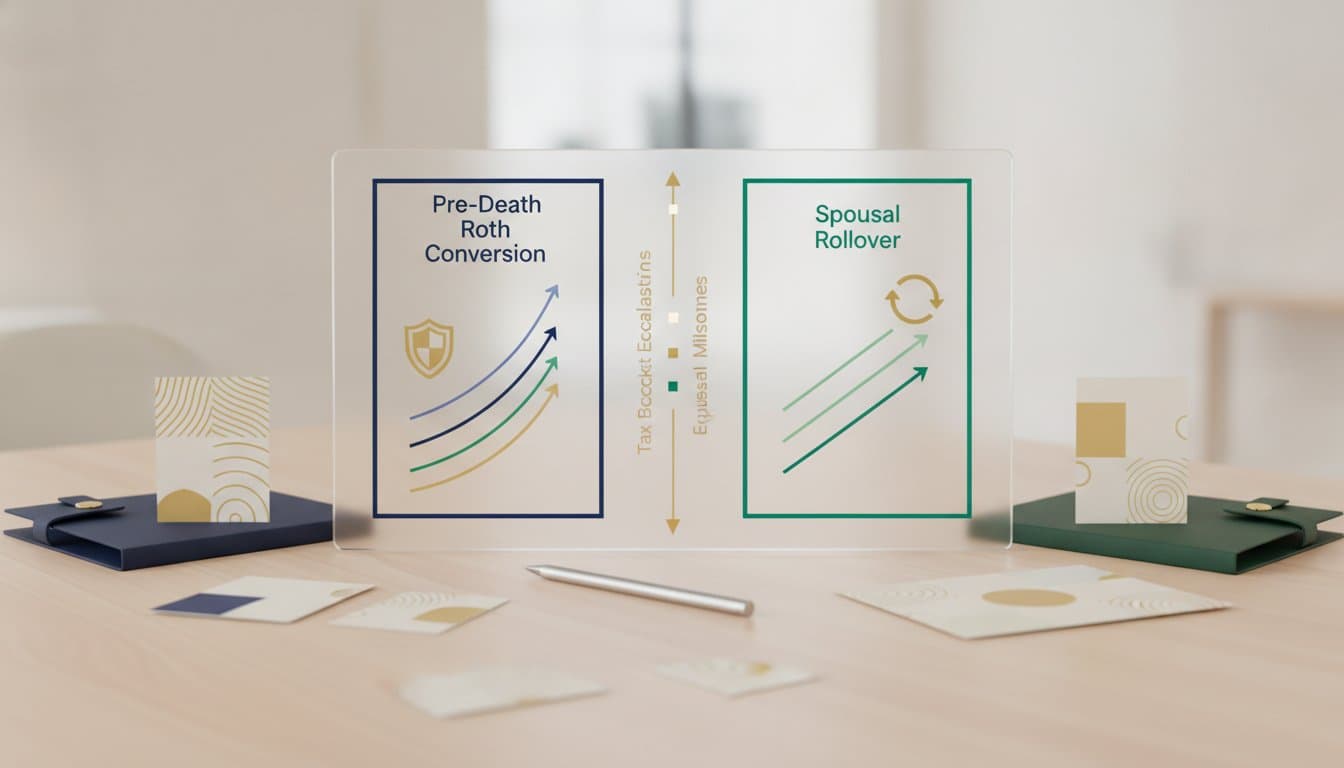
When the Widow Tax Trap Springs: Bracket Escalation Mechanics
The widow tax trap inherited IRA is a tax escalation scenario where a surviving spouse inherits a pre-tax retirement account and is forced into higher marginal tax brackets by the required minimum distributions (RMDs) from that account combined with their existing income.
The widow tax trap operates through a simple but punishing mechanism. When one spouse dies, the surviving spouse loses the married-filing-jointly tax brackets and shifts to single-filer brackets, which are roughly half the width. The 24% bracket for married couples filing jointly in 2026 covers taxable income from $100,525 to $191,950. For single filers, the 24% bracket starts at $50,650 and ends at $100,525.1
Now add an inherited IRA. Under the SECURE Act, non-spouse beneficiaries must deplete inherited IRAs within 10 years, creating a compressed tax window.2 A surviving spouse who does not elect the spousal rollover faces this 10-year rule. If the inherited IRA holds $400,000, the surviving spouse must withdraw at least $40,000 per year on average — on top of their existing income.
The Widow Tax Trap: How Inherited IRAs Trigger Surprise Tax Bills
The trap has three layers. First, the bracket compression described above. Second, the 10-year depletion rule forces withdrawals in years when the surviving spouse may already have peak income from Social Security and their own RMDs. Third, the surviving spouse cannot defer withdrawals to low-income years — the 10-year clock starts ticking the year after the original account owner's death.
Consider a hypothetical couple where the husband dies at age 78 with a $600,000 traditional IRA. The wife, age 75, receives $30,000 per year in Social Security survivor benefits and has her own $20,000 annual RMD from a separate IRA. If she elects the spousal rollover, she adds the $600,000 to her own IRA, increasing her future RMDs. Her combined RMDs might push her from the 22% bracket into the 32% bracket, costing an extra $8,000 to $12,000 per year in federal income tax.
If she does not elect the spousal rollover and instead treats the account as an inherited IRA, she must empty it within 10 years. Withdrawing $60,000 per year on top of her existing income could push her into the 35% bracket. The widow tax trap inherited IRA is not a theoretical risk — it is a mechanical consequence of the tax code.
| Strategy | Tax Timing | RMDs | 10-Year Rule | Best When |
|---|---|---|---|---|
| Pre-Death Roth Conversion | Pay now at known rate | Eliminated after conversion | Does not apply | Healthy spouse can convert during low-income years |
| Spousal Rollover | Pay later on withdrawals | Continue based on survivor's life expectancy | Does not apply to surviving spouse | Survivor needs near-term income access |
| Inherited IRA (No Rollover) | Pay later on withdrawals | 10-year depletion required | Mandatory | Survivor can manage bracket impact with strategic timing |
Why Roth Conversions Before Age 72 Reduce Future RMD Pain
Pre-death Roth conversions convert pre-tax IRA funds at current tax rates, eliminating future RMD requirements and preventing surviving spouse bracket escalation.3 The logic is straightforward: pay tax now at a known rate, or let the surviving spouse pay tax later at an unknown — and likely higher — rate.
The optimal window for Roth conversions is the gap between retirement and the start of RMDs. Under the SECURE 2.0 Act, the RMD age increased to 73 in 2023 and will reach 75 by 2033.4 For a couple retiring at 65, that creates an 8-to-10-year window of low-income years before RMDs begin.
During those years, the couple can convert IRA funds up to the top of their current marginal bracket. For example, suppose a couple has $50,000 in annual income from part-time work and investment earnings. They can convert approximately $40,000 per year while staying in the 12% bracket. Over eight years, that is $320,000 converted at a 12% tax rate — far below the 32% or 35% rate the surviving spouse would face on inherited IRA RMDs.
The pre-death Roth conversion strategy is especially powerful when one spouse has declining health. The healthy spouse can convert the sick spouse's IRA funds while the couple still files jointly, using the wider married brackets. After the sick spouse dies, the surviving spouse files as single — and the Roth funds are already tax-free.
Spousal Rollover Rules: What Surviving Spouses Must Know
A surviving spouse who elects spousal rollover treats the deceased spouse's IRA as their own, avoiding the 10-year rule but potentially pushing RMDs into higher brackets.5 The election is not automatic — the surviving spouse must affirmatively designate the account as their own, typically by retitling the IRA or making a spousal rollover contribution.
The key decision point: does the surviving spouse need the income from the inherited IRA in the near term? If yes, the spousal rollover may be the better choice because it allows penalty-free withdrawals before age 59½. If no, the inherited IRA treatment with the 10-year rule may be preferable — but only if the surviving spouse can manage the tax bracket impact.
The spousal rollover election rules also affect RMD timing. If the deceased spouse had already reached their RMD age, the surviving spouse must continue taking RMDs based on the deceased spouse's life expectancy until the account is retitled. If the deceased spouse had not reached RMD age, the surviving spouse can defer RMDs until their own RMD age.
A common mistake: assuming the spousal rollover is always the best option. For a surviving spouse with significant other income, the inherited IRA treatment with strategic withdrawals over 10 years may produce a lower total tax bill — especially if the surviving spouse can time withdrawals to low-income years.
Coordinating Social Security Filing with Roth Conversion Timing
Social Security survivor benefits add another layer to the Roth conversion decision. Surviving spouses retain Social Security survivor benefits at 100% of the deceased spouse's benefit if claiming age exceeds full retirement age.6 This means the surviving spouse's income floor is higher than expected, which narrows the room for low-tax Roth conversions.
The coordination strategy: front-load Roth conversions in the years before the surviving spouse claims survivor benefits. If the healthy spouse is 66 and the sick spouse is 70, the healthy spouse can convert IRA funds at a 12% or 22% rate for several years before survivor benefits begin. Once survivor benefits start, the additional income pushes the surviving spouse into higher brackets, making further conversions less attractive.
Consider a hypothetical scenario: a 68-year-old husband with declining health has a $500,000 traditional IRA. His 66-year-old wife plans to claim survivor benefits at her full retirement age of 67. In the one-year window before she claims benefits, the couple can convert $50,000 at a 12% rate. After she claims $24,000 per year in survivor benefits, the same conversion would cost 22% or more.
The Roth conversion before spouse dies strategy works best when the healthy spouse has low earned income and can control other income sources. Delaying Social Security filing, minimizing capital gains realizations, and avoiding large IRA withdrawals all create room for conversions at lower rates.
IRMAA Surcharges: How Large Conversions Raise Medicare Premiums
Roth conversions count as income for Medicare premium calculations under the Income-Related Monthly Adjustment Amount (IRMAA) rules. The IRMAA lookback period uses the tax return from two years prior — so a 2025 Roth conversion affects 2027 Medicare Part B and Part D premiums.
The IRMAA brackets are not wide. For 2025, the first IRMAA threshold for married filing jointly is $212,000 of modified adjusted gross income (MAGI). 2026 IRMAA thresholds are not yet published by CMS. Above that threshold, each spouse pays an additional $69.90 per month for Part B and $12.90 per month for Part D — a combined annual surcharge of $1,987.20 per couple.7
A large Roth conversion that pushes MAGI above $212,000 triggers IRMAA surcharges for two years. For a couple converting $100,000 in a single year, the IRMAA cost is approximately $4,000 over two years. That is not a reason to avoid conversions — it is a reason to spread conversions across multiple years to stay below IRMAA thresholds.
The optimal approach: convert up to the IRMAA threshold each year, then stop. For a couple with $80,000 in other income, that means converting approximately $130,000 per year while staying below the $212,000 IRMAA threshold. Over five years, that is $650,000 converted at manageable tax rates with minimal IRMAA impact.
The Five-Year Roth Clock: Planning for Tax-Free Withdrawals
Roth IRA funds are not immediately tax-free. The five-year rule requires that a Roth IRA be open for at least five tax years before qualified distributions — including earnings — can be withdrawn tax-free.8 For Roth conversions, each conversion has its own five-year clock.
This matters for the widow tax trap inherited IRA strategy because the surviving spouse may need access to Roth funds within five years of the conversion. If the sick spouse dies three years after a Roth conversion, the surviving spouse can withdraw the converted principal (the amount that was taxed) at any time without penalty. But the earnings on that principal are not tax-free until the five-year clock expires.
The planning implication: start Roth conversions early. A couple with a sick spouse in their early 60s should begin conversions immediately, even if the amounts are small. By the time the sick spouse passes at age 70, the five-year clock on the earliest conversions will have expired, giving the surviving spouse full access to tax-free Roth funds.
For couples where the sick spouse is already in their late 70s, the five-year clock is less relevant — the surviving spouse will likely need the Roth funds for income, not growth. In that case, the primary benefit is eliminating future RMDs, not tax-free growth.
Case Study: A 64-Year-Old Couple's Pre-Retirement Conversion Plan
Consider a hypothetical couple: Michael, age 64, and Jennifer, age 62. Michael has declining health and a $700,000 traditional IRA. Jennifer has $200,000 in her own IRA and expects $30,000 per year in Social Security survivor benefits after Michael passes.
The couple's current income is $60,000 from part-time consulting and investment earnings. They file jointly, placing them in the 12% marginal bracket with room to convert approximately $40,000 per year before hitting the 22% bracket.
Their plan: convert $40,000 of Michael's IRA each year for five years, from age 64 to 68. Total converted: $200,000 at a 12% tax rate. At age 68, Michael's health declines further, and they stop conversions. Michael passes at age 70.
Jennifer inherits the remaining $500,000 in Michael's IRA. She elects the spousal rollover, adding the funds to her own IRA. Her RMDs at age 73 will be based on a $700,000 balance (her $200,000 plus the $500,000 inherited). Her annual RMD at age 73 is approximately $26,400, based on the IRS uniform lifetime table factor of 26.5.9
Without the Roth conversions, Jennifer's RMDs would have been approximately $34,000 per year — $7,600 more. Over her 20-year life expectancy, that extra RMD income would cost her approximately $38,000 in additional federal income tax at a 22% marginal rate, plus state taxes.
The $200,000 in Roth conversions cost $24,000 in federal tax (12% of $200,000). The tax savings from reduced RMDs over 20 years total approximately $38,000. Net savings: $14,000, plus the benefit of having $200,000 in tax-free Roth funds that Jennifer can withdraw at any time without affecting her tax bracket.
Your Next Step
Review your current IRA beneficiary designations and estimate the surviving spouse's projected income after the first spouse's death. Calculate the marginal tax rate the surviving spouse would face on inherited IRA RMDs using the single-filer brackets. If that rate exceeds 22%, begin a pre-death Roth conversion plan immediately — convert up to the top of your current marginal bracket each year, staying below IRMAA thresholds. Work with a CPA or tax professional to model the multi-year conversion schedule and confirm the spousal rollover election timing. The earlier you start, the more years you have to convert at lower rates.
Footnotes
-
https://www.irs.gov/retirement-plans/retirement-plans-faqs-concerning-widows-and-widowers ↩
-
https://www.carrolladvisory.com/blog/how-roth-conversions-help-avoid-the-widows-tax-penalty ↩
-
https://www.congress.gov/bill/117th-congress/house-bill/5376 ↩
-
https://www.irs.gov/retirement-plans/plan-participant-employee/retirement-topics-beneficiary ↩