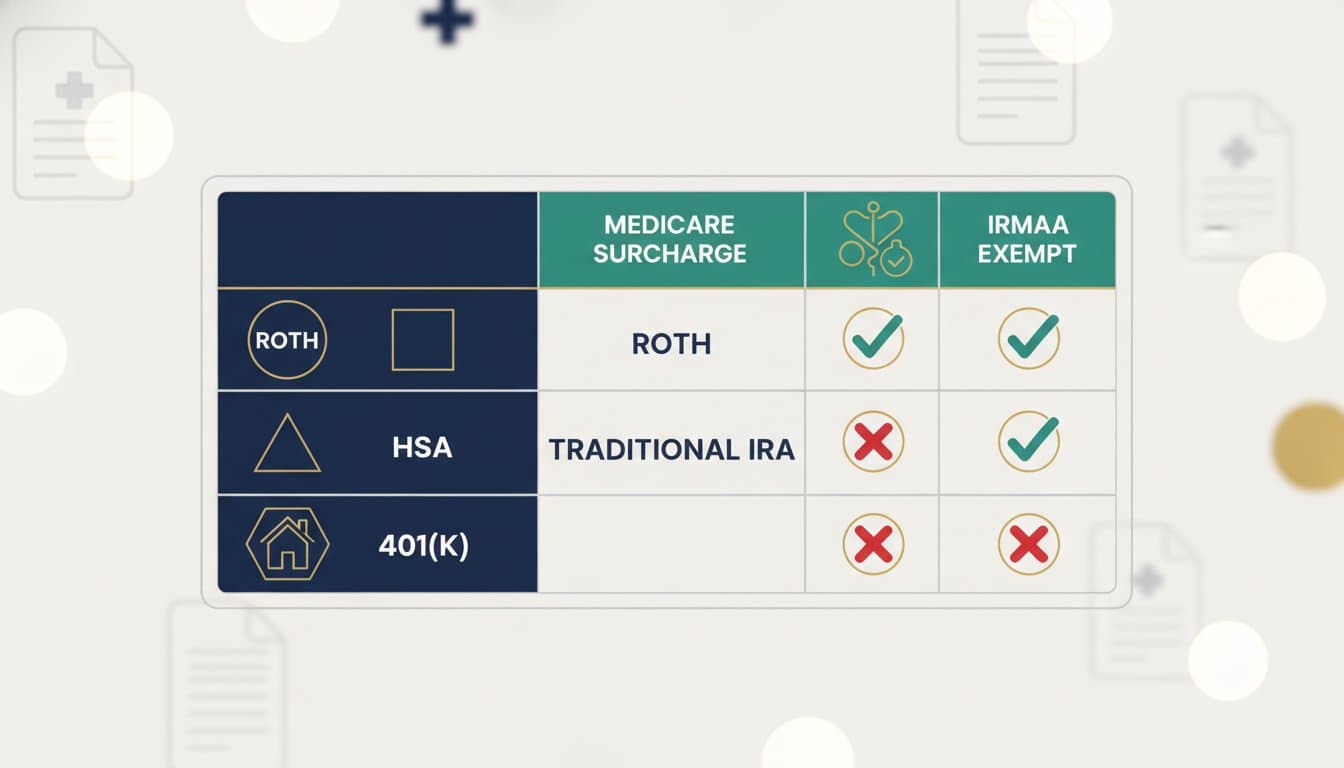
IRMAA (Income-Related Monthly Adjustment Amount) is a surcharge added to your standard Medicare Part B and Part D premiums if your Modified Adjusted Gross Income (MAGI) exceeds certain thresholds. Understanding what counts toward IRMAA income is critical for retirees managing withdrawals, as only distributions from taxable accounts like Traditional IRAs, 401(k)s, and pensions are included in the MAGI calculation used by Medicare. Roth IRA withdrawals, HSA funds for medical expenses, and return-of-principal from non-qualified annuities generally do not increase your income for IRMAA purposes. Updated for 2026.
What IRMAA Is and Why Your Withdrawal Mix Matters
Your Medicare Part B and D premiums are based on your income, but not all money you take from your retirement accounts counts toward that calculation. Understanding what counts toward IRMAA income is critical for avoiding unexpected premium surcharges when you need to make large withdrawals.
The Income-Related Monthly Adjustment Amount (IRMAA) is a surcharge added to your standard Medicare Part B and Part D premiums if your Modified Adjusted Gross Income (MAGI) exceeds certain thresholds1. The IRS uses your tax return from two years prior to determine your premiums; for example, your 2026 Medicare costs are based on your 2024 income2. This two-year lag means a one-time financial event, like a large traditional IRA withdrawal, can impact your healthcare costs long after the money is spent.
The surcharge applies in tiers. For a single filer, the first IRMAA threshold for 2026 premiums starts at a MAGI above $103,0003. Each successive tier increases the monthly surcharge for both Part B and Part D. The financial impact is substantial and often overlooked in withdrawal planning. A married couple filing jointly whose MAGI crosses into a higher bracket by just a few thousand dollars could face hundreds more in premiums each month for two full years.
This system makes your withdrawal strategy paramount. Drawing from a taxable brokerage account has a different impact on your MAGI than taking the same amount from a Roth IRA. A retiree who needs a large sum for a home repair or a new car must consider not just the tax bill but the potential IRMAA trigger. Managing your MAGI becomes a continuous exercise in balancing cash flow needs against future Medicare costs.
How the IRS Calculates MAGI for Medicare Surcharges
The cornerstone of IRMAA is Modified Adjusted Gross Income. For most retirees, this calculation begins with the Adjusted Gross Income (AGI) figure on your tax return. The IRS then makes specific "add-backs" to this number to arrive at your IRMAA MAGI4.
| Income Component | Counts Toward IRMAA MAGI? | Notes |
|---|---|---|
| Traditional IRA/401(k) Withdrawal | Yes | Fully taxable, so it's included in AGI. |
| Roth IRA Distribution (Qualified) | No | Not included in gross income. |
| Social Security Benefits (Taxable Portion) | Yes | Included in AGI if total income exceeds thresholds. |
| Tax-Exempt Interest | Yes | Added back to AGI for IRMAA calculation. |
| HSA Distribution for Non-Qualified Expense | Yes | Taxable penalty, included in AGI. |
| Capital Gains | Yes | Included in AGI. |
The most critical add-back for retirees is tax-exempt interest. While this income is excluded from your AGI, it is added back for the specific purpose of calculating your IRMAA MAGI5. This means income from municipal bonds, often considered tax-free, still counts when determining your Medicare premiums.
The calculation uses your filing status and income from the tax return two years prior. If you filed as "Married Filing Jointly" for 2024, you will use the joint income thresholds for your 2026 IRMAA determination. If your income has dropped since that tax year due to a qualifying life event—such as retirement, divorce, or the death of a spouse—you can file an appeal to have your IRMAA reduced using more current income information6.
Traditional 401(k) and IRA Withdrawals—The Full Hit
Distributions from traditional, tax-deferred accounts represent the most straightforward impact on IRMAA. Every dollar you withdraw from a traditional IRA, 401(k), 403(b), or similar plan is treated as ordinary income. This amount is reported in Box 1 of Form 1099-R and flows directly into your AGI on your tax return. Consequently, it counts fully toward your IRMAA income.
Consider a retiree, Michael, who takes a $40,000 distribution from his traditional IRA to fund a home renovation. That entire $40,000 is included in his AGI and counts fully toward his IRMAA income. If this withdrawal pushes his MAGI from $100,000 to $140,000, he may cross an IRMAA threshold, triggering higher Part B and Part D premiums for two years.
Required Minimum Distributions (RMDs) are no exception. Once you reach the age at which RMDs begin, the forced withdrawal from your traditional retirement accounts is also taxable income and counts toward MAGI. This can create an unavoidable IRMAA cliff for retirees with large tax-deferred balances. Proactive planning, such as executing partial Roth conversions in lower-income years before RMDs begin, can help mitigate this future MAGI spike.
Roth Distributions—Why They Are IRMAA-Exempt
Qualified distributions from a Roth IRA or Roth 401(k) are the most powerful tool for managing IRMAA. Because contributions to these accounts were made with after-tax dollars, the IRS does not consider qualified withdrawals—those of earnings taken after age 59½ with at least a five-year holding period—to be taxable income. Since they are not included in your gross income, they are excluded from your AGI and do not count toward your IRMAA income7.
This provides significant flexibility. Suppose Jennifer needs $50,000 from her portfolio in a given year. If she takes it all from her traditional IRA, her MAGI increases by $50,000. If, instead, she can take $30,000 from her Roth IRA and only $20,000 from her traditional IRA, her reported MAGI increases by only $20,000, potentially keeping her below a critical IRMAA threshold.
However, Roth conversions are a different story. Converting funds from a traditional IRA to a Roth IRA is a taxable event in the year of the conversion. The converted amount is added to your taxable income. For instance, converting $20,000 from a traditional IRA to a Roth IRA adds $20,000 to your taxable income for the year, increasing your MAGI and potentially triggering IRMAA. The benefit is that future qualified withdrawals from that converted amount will be IRMAA-exempt.
Social Security Benefits and Your MAGI Count
Many retirees are surprised to learn that Social Security benefits can contribute to the MAGI used for IRMAA. The portion of your benefits that is subject to federal income tax is included in your AGI. Whether your benefits are taxable depends on your "combined income" (AGI + nontaxable interest + half of your Social Security benefits). If you are a single filer with a combined income between $25,000 and $34,000, up to 50% of your benefits may be taxable. If your combined income exceeds $34,000, up to 85% can be taxable8. For joint filers, the 50% threshold is between $32,000 and $44,000, and the 85% threshold applies above $44,0008. This taxable portion is then included in your AGI and counts toward your IRMAA MAGI.
This creates a circular effect: higher income from other sources (like IRA withdrawals) can cause more of your Social Security to become taxable, which in turn increases your AGI further, potentially pushing you into a higher IRMAA tier. Careful income planning must account for this interaction to avoid an accelerating tax and premium burden.
Overlooked Income Sources: RMDs, Box 1 W-2 Income, and Taxable Interest
Beyond retirement account withdrawals, other common income sources fully count toward IRMAA MAGI and must be factored into annual planning.
W-2 Income (Box 1) is a common trigger for IRMAA among individuals who work past age 65. If you or your spouse are still working, even part-time, the wages reported in Box 1 of your W-2 are included in AGI.
Taxable Interest and Dividends from savings accounts, CDs, bonds, and dividends from investments held in taxable brokerage accounts are reported on your 1099-INT and 1099-DIV and flow into your AGI.
Capital Gains from selling stocks, bonds, or property are included. This includes capital gains distributions from mutual funds.
Annuity Payments from non-qualified annuities are partially taxable. The earnings portion of payments counts toward MAGI.
Non-Qualified HSA Distributions carry significant tax consequences. If you use Health Savings Account funds for non-medical expenses before age 65, the distribution is included in income and subject to a 20% penalty. That taxable amount counts toward IRMAA MAGI.
As noted earlier, tax-exempt interest is a uniquely overlooked source. While it offers federal income tax exemption, it is added back for IRMAA purposes. A retiree with a significant portion of their portfolio in municipal bonds must still account for that interest when forecasting their Medicare premium surcharges.
Timing Your Withdrawals to Stay Below the Next Threshold
Strategic timing of withdrawals from different account types can help manage your MAGI and avoid IRMAA cliffs. The goal is to smooth your taxable income over time, preventing sharp spikes that push you into a higher surcharge tier.
A practical approach involves creating a multi-year income plan. In years where your other income is low, you might intentionally realize some capital gains or execute a partial Roth conversion, using up the space in your current tax and IRMAA bracket. In years where you anticipate higher income—perhaps from a part-time job or a large RMD—you would prioritize pulling needed cash from Roth accounts or the principal portion of taxable brokerage accounts to minimize adding to your MAGI.
Consider the IRMAA threshold brackets. The difference in monthly surcharge between the first and second tier for a single filer is significant. If your projected MAGI is close to a threshold, it may be worth slightly accelerating or deferring a traditional IRA withdrawal or capital gain realization to stay under the line. The savings from avoiding the IRMAA surcharge for two years can outweigh the benefit of taking the distribution in a specific calendar year.
How to Appeal an IRMAA Determination if Your Income Drops
The Social Security Administration issues IRMAA determinations based on tax data from two years ago, but you are not locked in if your financial situation has changed. SSA handles appeals for what it calls "life-changing events." You must file an appeal, using Form SSA-44, within 60 days of receiving your IRMAA determination notice9.
Qualifying events include retirement (you stopped working or reduced your work hours), loss of income-producing property (you lost income due to a disaster or other event beyond your control), death of a spouse (your marital status changed), divorce or annulment, and work stoppage or reduction for you or your spouse. Also qualifying: loss of pension income.
The appeal requires documentation. For retirement, you may need a letter from your former employer or copies of filed tax returns showing reduced income. SSA will recalculate your IRMAA using a more recent tax year or an estimate of your current calendar year income. If successful, the adjustment can be applied prospectively, potentially saving you thousands of dollars in premiums.
Your Next Step
Review your most recent Medicare IRMAA determination letter from the Social Security Administration and your tax return from two years prior. Identify the MAGI that triggered your current premium level. Then, project your expected income for this year, categorizing each source as either counting or not counting toward IRMAA MAGI. If a large, necessary withdrawal is on the horizon, model taking it from different account types (e.g., Roth vs. Traditional IRA) to see the impact on your projected MAGI and potential surcharges. This simple exercise clarifies the direct financial trade-off between your withdrawal choices and your future healthcare costs.