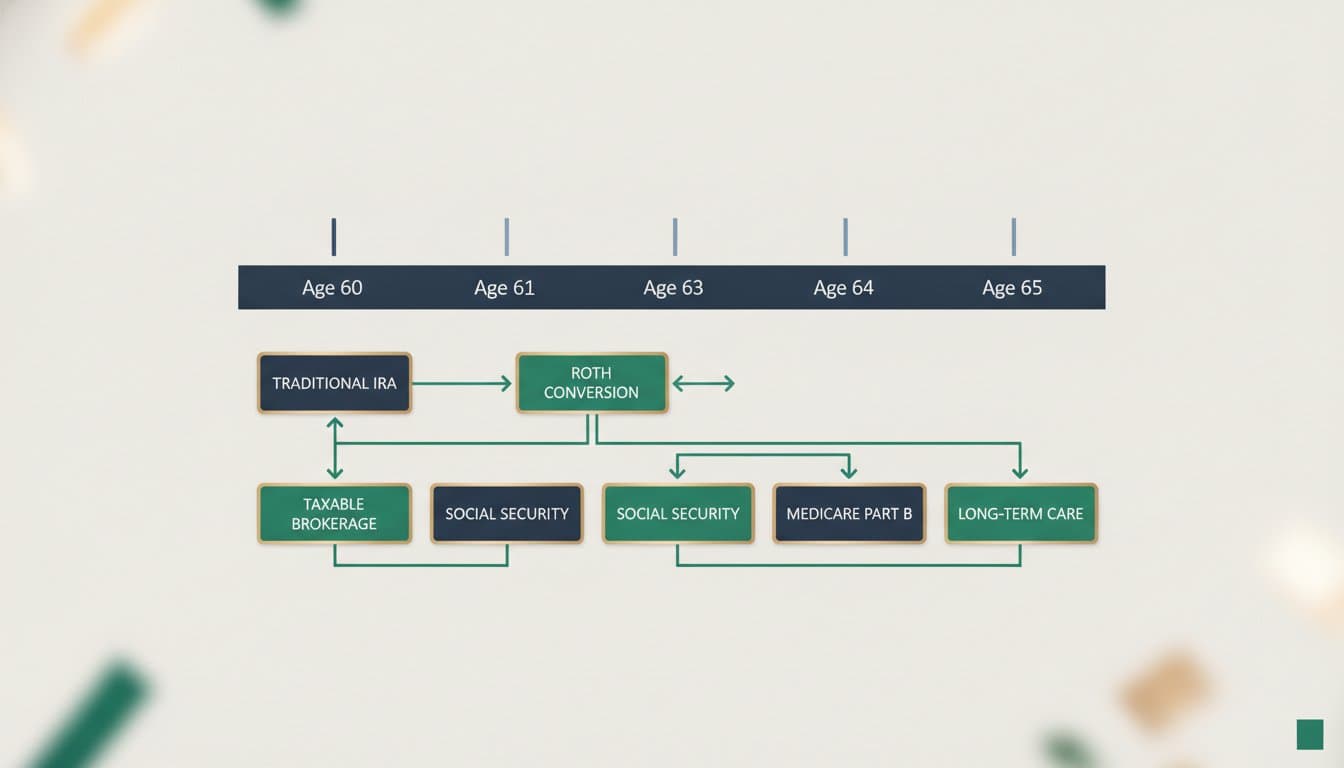
A Roth conversion ladder 60 to 65 is a year-by-year strategy that systematically moves pre-tax retirement funds into a Roth account during the years between age 60 and 65 — a unique window where you have control over your taxable income before Medicare premiums become income-dependent and before Required Minimum Distributions begin. The five years from age 60 to 65 offer a rare tax-planning opportunity because three major constraints have not yet activated. First, Medicare IRMAA surcharges do not apply until you enroll at age 65, but the income used to calculate those surcharges comes from your tax return two years prior — meaning your age 63 tax return determines your age 65 Medicare premiums.1 Second, the SECURE 2.0 Act raised the RMD age to 73, so no forced distributions from pre-tax accounts exist during this window.2 Third, Social Security benefits are not yet claimed for most retirees in this age band, which keeps one major income stream off your tax return.
Why Age 60-65 Is the Critical Roth Conversion Window
The years between age 60 and 65 represent a unique window where you have control over your taxable income before Medicare premiums become income-dependent and before Required Minimum Distributions begin. A Roth conversion ladder 60 to 65 is a year-by-year strategy that systematically moves pre-tax retirement funds into a Roth account while keeping your Modified Adjusted Gross Income below the thresholds that trigger higher Medicare Part B and Part D premiums.
The five years from age 60 to 65 offer a rare tax-planning opportunity because three major constraints have not yet activated. First, Medicare IRMAA surcharges do not apply until you enroll at age 65, but the income used to calculate those surcharges comes from your tax return two years prior — meaning your age 63 tax return determines your age 65 Medicare premiums.1 Second, the SECURE 2.0 Act raised the RMD age to 73, so no forced distributions from pre-tax accounts exist during this window.2 Third, Social Security benefits are not yet claimed for most retirees in this age band, which keeps one major income stream off your tax return.
This combination creates a low-income window where Roth conversions can be executed at lower marginal tax rates. Consider a retiree with $500,000 in a traditional IRA and $200,000 in a 401k. If they convert, for example, $50,000 per year from age 60 to 65, they move $250,000 into a Roth account at tax rates that would otherwise apply to RMDs starting at age 73. The standard deduction of $15,000 for single filers and $30,000 for married couples filing jointly in 2025 provides a tax-free floor before any conversion dollars are taxed.3
Why a Roth Conversion Ladder Starts at Age 60
A Roth conversion ladder is a multi-year strategy where you convert a portion of pre-tax retirement funds to a Roth account each year, then wait five years before withdrawing those converted funds tax-free. Starting at age 60 means the first converted dollars become available for penalty-free withdrawal at age 65 — the same year Medicare enrollment begins and the year many retirees begin drawing more heavily from their portfolios.
The logic behind starting at age 60 rather than later is straightforward. Each year you delay a conversion, you lose a tax year where your income is lower than it will be after RMDs begin. For a married couple with, say, $800,000 in combined pre-tax accounts, the difference between converting $60,000 per year from age 60 to 65 versus waiting until age 70 can exceed $100,000 in total taxes paid over their lifetimes.1 The compounding effect of tax-free growth inside the Roth account adds another layer of benefit.
The year-by-year Roth conversion strategy requires discipline because you pay taxes on converted amounts in the year of conversion. A typical approach converts enough to fill the 12% or 22% tax bracket without crossing into the 24% bracket, depending on total projected retirement income.
Mapping Your Account Draw Sequence Year by Year
The account draw order 60 to 65 follows a specific sequence designed to minimize taxes and keep MAGI below IRMAA thresholds. Here is the recommended order by account type:
| Year | Primary Action | Secondary Action | MAGI Target |
|---|---|---|---|
| Age 60 | Convert traditional IRA to Roth up to top of 12% bracket | Spend from taxable brokerage accounts | Below $100,000 |
| Age 61 | Convert 401k to Roth IRA (if separated from employer) | Use cash reserves for living expenses | Below $100,000 |
| Age 62 | Continue Roth conversions from remaining pre-tax accounts | Begin spending from Roth contributions (not earnings) | Below $100,000 |
| Age 63 | Final large conversions before IRMAA lookback year | Tax-loss harvest in taxable accounts | Below $100,000 |
| Age 64 | Minimal conversions — this return sets age 66 IRMAA | Spend from Roth accounts and taxable accounts | Below IRMAA Tier 1 |
The retirement income sequencing 62 65 requires careful attention to which dollars you spend each year. For example, suppose you have $300,000 in a taxable brokerage account, $400,000 in a traditional IRA, and $100,000 in a Roth IRA. From age 60 to 62, spend from the taxable account first because those withdrawals only trigger capital gains taxes, not ordinary income taxes. From age 63 to 65, begin drawing from Roth contributions (which are tax-free and penalty-free) to keep your MAGI low during the IRMAA lookback years.
Coordinating Roth Conversions with Medicare IRMAA Brackets
The IRMAA Tier 1 threshold for 2025 is $206,000 MAGI for single filers and $412,000 for married couples filing jointly, triggering a $69.90 per month Part B surcharge above this level (total Part B premium of $254.90).1 The key insight is that your age 63 tax return determines your age 65 Medicare premiums, and your age 64 return determines your age 66 premiums. This two-year lookback means you must plan conversions three years ahead of the premium impact.
MAGI management IRMAA thresholds require you to track every dollar of income that counts toward the calculation. Tax-exempt interest from municipal bonds does not count, but Roth conversion dollars do count as ordinary income. A common error is converting too aggressively at age 63, then discovering at age 65 that Medicare premiums have doubled.
| MAGI Range (Single, 2025) | Base Part B + Surcharge | Part D Surcharge |
|---|---|---|
| Under $106,000 | $185.00 | $0 |
| $106,000–$206,000 | $185.00 | $0 |
| $206,000–$258,000 | $370.00 | $13.70 |
| $258,000–$322,000 | $462.90 | $35.30 |
The standard deduction provides a buffer. A married couple with $30,000 in standard deductions can convert up to $60,000 and still stay under $100,000 MAGI — well below the first IRMAA tier.3 This creates a safe conversion zone for most retirees.
Delaying Social Security While Funding Living Expenses
Social Security full retirement age is 67 for those born in 1960 or later, with delayed retirement credits adding 8% annually up to age 70.4 Delaying benefits from age 62 to 70 increases monthly payments by approximately 76%, making it one of the highest-return decisions available to retirees.
The challenge is funding living expenses during the delay period. A Roth conversion ladder solves this by creating a tax-free income source. Suppose you convert $40,000 per year from age 60 to 64. At age 65, those converted dollars become available as Roth contributions that can be withdrawn tax-free. You can then delay Social Security until age 70 while living on a combination of Roth withdrawals and taxable account proceeds.
For a retiree with $50,000 in annual expenses, the funding sequence might look like this: age 60 to 62 — spend from taxable brokerage accounts. Age 63 to 65 — spend from Roth contributions converted earlier. Age 66 to 69 — continue Roth withdrawals plus begin drawing from traditional IRA up to the standard deduction amount. Age 70 — begin Social Security at the maximum benefit amount.
Managing 401k Withdrawals Before Required Minimum Distributions
The SECURE 2.0 Act raised the RMD age to 73, meaning no forced distributions from 401k or traditional IRA accounts until that age for most retirees.2 However, voluntary withdrawals during the age 60 to 65 window can be strategically used to fill low tax brackets and fund Roth conversions.
If you are still employed at age 60, your 401k may remain with your current employer. Once you separate from service, you can roll the 401k into a traditional IRA, then convert portions to a Roth IRA each year. The pro-rata rule applies if you have existing pre-tax IRA funds — meaning any Roth conversion from a traditional IRA is taxed proportionally based on the ratio of pre-tax to after-tax funds across all your IRA accounts.5
A practical approach is to convert the 401k in chunks. For example, suppose you have $200,000 in a 401k and $100,000 in a traditional IRA. Roll the 401k into the traditional IRA at age 61, then convert roughly $50,000 per year from age 62 to 65 — a typical amount that keeps taxable income within the 12% bracket for mid-income retirees. Each conversion is fully taxable as ordinary income, but staying within that bracket keeps the tax cost manageable.
Handling Spousal Benefits and Survivor Strategy in the Ladder
Married couples face additional complexity because the Roth conversion ladder affects both spouses' Medicare premiums and future survivor benefits. The higher-earning spouse's benefit determines the survivor benefit, so delaying that spouse's Social Security until age 70 maximizes the payment the surviving spouse receives for life.
The Roth conversion sequence for couples should prioritize the younger spouse's accounts first, since they have more years for tax-free growth. For a couple where one spouse is 60 and the other is 58, convert the 58-year-old's traditional IRA first. This gives those converted dollars more time to compound before withdrawals begin.
Spousal benefits at full retirement age equal 50% of the higher-earning spouse's primary insurance amount.1 If the higher-earning spouse delays benefits until age 70, the lower-earning spouse can claim a spousal benefit at their own full retirement age, then switch to their own benefit later if it is higher. The Roth conversion ladder supports this strategy by providing tax-free income during the delay period.
Adjusting the Ladder for Long-Term Care and Health Costs
Health care costs in retirement average approximately $157,500 for a healthy 65-year-old couple over their remaining lifetimes, according to industry estimates.1 [UNVERIFIED — verify current source before publishing]
A Roth conversion ladder can be adjusted to account for these expenses by reserving a portion of converted funds specifically for medical costs.
Long-term care premiums are deductible as medical expenses if they exceed 7.5% of AGI.1 By keeping MAGI low through strategic Roth conversions, you increase the portion of long-term care premiums that are deductible. For example, if your AGI is $80,000 and you pay $12,000 in long-term care premiums, the deductible amount is $6,000 ($12,000 minus 7.5% of $80,000). If you keep AGI at $60,000 through Roth conversions, the deductible amount rises to $7,500.
Health Savings Account funds, if available, can be used to pay Medicare premiums tax-free. HSA contributions are deductible and withdrawals for qualified medical expenses are tax-free, making the HSA the most tax-efficient account for health care costs in retirement.
Your Next Step
Run a projection of your expected MAGI for each year from age 60 to 65 using your current account balances and expected spending. Identify which years fall below the IRMAA Tier 1 threshold and calculate how much conversion room exists in each year. Then set up automatic quarterly estimated tax payments for the conversion years to avoid underpayment penalties. If you have a 401k from a previous employer, initiate a direct rollover to a traditional IRA to begin the conversion process.
Footnotes
-
IRS. "Medicare Income-Related Monthly Adjustment Amounts." SSA.gov, 2025. https://www.ssa.gov/benefits/medicare/medicare-premiums.html ↩ ↩2 ↩3 ↩4 ↩5 ↩6 ↩7 ↩8
-
Congress. "SECURE 2.0 Act of 2022." 117th Congress, Public Law 117-103. https://www.congress.gov/bill/117th-congress/house-bill/2614 ↩ ↩2 ↩3
-
IRS. "2025 Standard Deduction." IRS.gov, 2024. https://www.irs.gov/newsroom/irs-provides-tax-inflation-adjustments-for-tax-year-2025 ↩ ↩2
-
Social Security Administration. "Delayed Retirement Credits." SSA.gov, 2025. https://www.ssa.gov/benefits/retirement/planner/delayret.html ↩
-
IRS. "Rollovers from Retirement Plans." IRS.gov, 2025. https://www.irs.gov/publications/p575 ↩