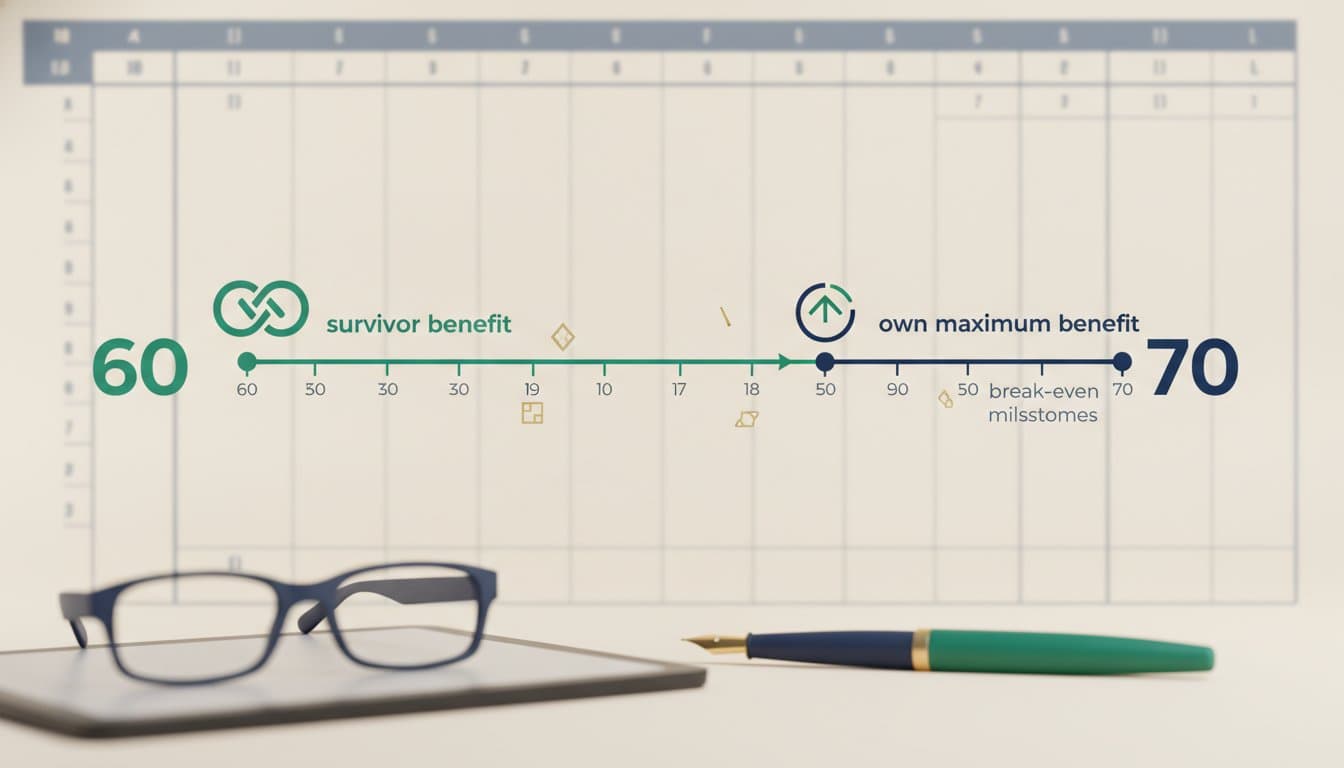
How the Age-60 vs Age-70 Claiming Decision Works
The Social Security survivor benefit for widows age 60 is calculated as 71.5% of the deceased worker's Primary Insurance Amount when claimed at age 60, with the reduction decreasing incrementally the closer the widow gets to full retirement age.1
A widow turning 60 faces a choice with permanent financial consequences: claim the survivor benefit immediately at a reduced rate, or delay to receive the full amount. The survivor benefit reduction at age 60 is 28.5% compared to what would be available at full retirement age of 67.2 For a deceased worker with a Primary Insurance Amount of $2,000, the survivor benefit at age 60 would be approximately $1,430 per month, versus $2,000 at full retirement age.
If her own retirement benefit at full retirement age exceeds the survivor benefit, she can claim the survivor benefit early and switch to her own benefit later, earning delayed retirement credits of 8% per year from full retirement age to age 70.3 This coordination strategy maximizes lifetime income by capturing the survivor benefit during the early years while allowing the widow's own benefit to grow.
Consider a hypothetical scenario: a widow age 60 with a deceased spouse's PIA of $2,400 and her own PIA of $1,800. Claiming the survivor benefit at 60 yields roughly $1,716 per month, for example. She can collect that for ten years while her own benefit grows to, say, approximately $2,376 at age 70, assuming the standard 8% annual delayed retirement credits.4 The total lifetime income from this strategy often exceeds claiming either benefit alone.
The Survivor-to-Own-Benefit Switch Explained
The Social Security Administration permits a widow to claim a reduced survivor benefit at age 60 and later switch to her own retirement benefit, provided her own benefit exceeds the survivor amount at the time of the switch.4 This is not an automatic process — the widow must file a specific application to transition benefits.
At full retirement age, her own benefit becomes available at its full PIA amount. If she delays claiming her own benefit beyond full retirement age, delayed retirement credits accumulate at 8% annually until age 70.3 At that point, she files for her own benefit, which has grown by 24% (three years of 8% credits), and the survivor benefit terminates.
For a widow whose own PIA is $1,500 and whose survivor benefit at 60 is $1,430, the switch at age 70 would yield her own benefit of $1,860 per month.4 The ten years of survivor payments totaling roughly $171,600 provide income during the delay period, while the higher own benefit locks in a larger inflation-adjusted payment for life.
When Waiting to Age 70 Actually Pays Off
Delaying the switch to age 70 produces the highest monthly benefit, but the break-even analysis depends on life expectancy. A widow who lives to average life expectancy — approximately age 85 for a 60-year-old woman — typically receives more total lifetime income by delaying her own benefit to 70.
| Claiming Strategy | Monthly Benefit | Break-Even Age |
|---|---|---|
| Own benefit at FRA ($2,000 PIA) | $2,000 | N/A |
| Own benefit at 70 ($2,000 PIA) | $2,480 | ~82.5 |
| Survivor at 60 + own at 70 | $1,716 → $2,376 | Varies by PIA |
The math: suppose a widow's own PIA is $2,000. Claiming at full retirement age yields $2,000 per month. Delaying to 70 yields $2,480 per month — an additional $480 per month1. The cost of waiting is the $2,000 per month she forgoes for three years, totaling $72,0002. The break-even point occurs roughly at age 82.5, when the cumulative higher payments from age 70 onward surpass the forgone benefits.
For widows with a family history of longevity or excellent health, the delay strategy is compelling. For those with shorter life expectancy or immediate income needs, claiming earlier may be the better choice. The survivor benefit collected from 60 to 70 provides a bridge that makes the delay financially feasible.
Tax Implications of Your Claiming Strategy
Social Security benefits become taxable when provisional income — adjusted gross income plus nontaxable interest plus half of Social Security benefits — exceeds certain thresholds. For a single filer, up to 50% of benefits are taxable when provisional income is between $25,000 and $34,0001, and up to 85% when it exceeds $34,0001.
A widow collecting the survivor benefit at 60 while also taking retirement account distributions faces a tax drag that reduces the net benefit of delaying. Suppose she takes $30,000 annually from an IRA to supplement the survivor benefit. That IRA distribution pushes provisional income higher, potentially triggering taxation on up to 85% of her survivor benefit1.
The strategy to minimize tax drag: use Roth IRA conversions before age 60 to create tax-free withdrawal sources, or hold cash reserves in taxable accounts to avoid forced IRA distributions during the survivor benefit years. A widow with, for example, $200,000 in a taxable brokerage account can draw living expenses from that account without increasing provisional income, preserving the tax-advantaged status of her survivor benefit.
IRMAA Surcharges and Medicare Premium Impact
Medicare Part B and Part D premiums are means-tested through the Income-Related Monthly Adjustment Amount, or IRMAA. For 2025, single filers with modified adjusted gross income above $106,000 pay surcharges ranging from $70 to $420 per month on top of the standard Part B premium.5
The two-year lookback rule means 2025 IRMAA is based on 2023 tax returns. A widow who sold a home or took a large IRA distribution in 2023 may face unexpected surcharges in 2025, precisely when she is collecting the survivor benefit. The standard Part B premium in 2025 is $185 per month, but IRMAA can push that to $605 per month for high-income beneficiaries.5
Widows planning the survivor benefit strategy should model their MAGI for the two-year lookback window. If a large distribution in year one triggers IRMAA in year three, the net benefit of the delay strategy shrinks. Filing an IRMAA appeal using Form SSA-44 with evidence of a life-changing event — such as the death of a spouse — can reduce or eliminate the surcharge.
Alternative Income Sources While Delaying
The survivor benefit at age 60 provides approximately 71.5% of the deceased worker's PIA, which may not cover living expenses.1 Widows need alternative income sources to bridge the gap until their own benefit begins at age 70.
Taxable brokerage accounts offer the most tax-efficient bridge income. Withdrawals from a brokerage account only trigger capital gains tax on the appreciation portion, and the principal is tax-free. For example, a widow with $300,000 in a brokerage account can withdraw $20,000 annually for 15 years without touching retirement accounts.
Roth IRA withdrawals are entirely tax-free and do not count toward provisional income for Social Security taxation. A widow who converted traditional IRA funds to a Roth IRA before age 60 can access those funds penalty-free after five years. Part-time work in a lower-income role — for example, consulting income of roughly $15,000 per year — provides income without pushing provisional income into the 85% taxation bracket.
Special Rules for Divorced Widows
A divorced widow qualifies for survivor benefits on her ex-spouse's record if the marriage lasted at least 10 years and she has not remarried before age 60.6 The same reduction rules apply: claiming at age 60 yields 71.5% of the ex-spouse's PIA.
The coordination strategy works identically for divorced widows. She can claim the reduced survivor benefit on her ex-spouse's record at 60 and switch to her own benefit at 70. If her ex-spouse has not yet claimed his own benefit, she can still claim the survivor benefit — the survivor benefit is based on the deceased worker's PIA, not their actual benefit amount.
Remarriage after age 60 does not affect survivor benefit eligibility. A widow who remarries at 62 can still collect survivor benefits on her deceased spouse's record. If the new spouse also dies, she may be eligible for survivor benefits on both records, though she can only collect the higher of the two.
Your Next Step
Download the Social Security Administration's benefit verification letter from your online account at ssa.gov to confirm your deceased spouse's earnings record and your own. Then schedule a 30-minute review with a fee-only financial planner who specializes in Social Security claiming strategies — not a commission-based advisor. Bring your benefit verification letter, your most recent tax return, and a list of your retirement account balances. Ask the planner to run three scenarios: claiming survivor benefits at 60 and switching at 70, claiming survivor benefits at full retirement age, and claiming your own benefit at 62. The roughly $300 to $500 you spend on this review will inform a decision worth tens of thousands of dollars in lifetime benefits1.
Footnotes
-
https://www.maximizemysocialsecurity.com/blog/social-security-survivor-benefits-explained ↩ ↩2 ↩3 ↩4 ↩5 ↩6 ↩7 ↩8
-
https://www.bankwithunited.com/thrive-home/a-guide-to-survivor-benefits-for-widows.html ↩ ↩2
-
https://www.ssa.gov/benefits/retirement/planner/delayret.html ↩ ↩2
-
https://247wallst.com/personal-finance/2026/05/19/why-a-60-year-old-widow-should-claim-survivor-benefits-now-and-switch-to-her-own-at-70 ↩ ↩2 ↩3
-
https://www.protective.com/learn/social-security-widows-benefits ↩ ↩2
-
https://www.ssa.gov/policy/docs/statcomps/supplement/2025/5a.html ↩