Disclaimer: This is not tax advice. Always consult a licensed CPA for your specific tax situation.
Why Your Withdrawal Order Matters More Than Your Savings Rate
A retirement withdrawal strategy is a planned sequence for taking money from different account types—like taxable brokerage, traditional IRAs, and Roth IRAs—to minimize your lifetime tax bill and make your savings last. You spent decades building your retirement portfolio. Now, as a retiree age 60+, the challenge shifts from accumulation to distribution. The order in which you pull money from your various accounts—your taxable brokerage, your traditional 401(k) or IRA, your Roth IRA, and Social Security—can have a dramatic impact on how long your money lasts and how much you pay in taxes over a 20-30 year retirement.
Getting this sequence wrong can trigger unnecessary taxes, push you into a higher tax bracket, increase Medicare premiums, and even cause your Social Security benefits to become taxable. The goal is to control your taxable income each year to stay within favorable tax brackets, thereby preserving more of your wealth for you and your heirs.
The Core Principle: Managing Your Taxable Income
Retirement withdrawal strategy is a planned sequence for taking money from different account types to minimize your lifetime tax bill and make your savings last. The entire logic behind a tax-efficient retirement withdrawal strategy hinges on one concept: managing your annual taxable income. Every dollar you withdraw from a pre-tax account (like a traditional IRA or 401(k)) is treated as ordinary income by the IRS1. This income fills up your standard deduction and tax brackets.
As of 2026, the tax brackets and standard deduction are projected to adjust for inflation. If tax provisions from the Tax Cuts and Jobs Act sunset as scheduled after 2025, brackets may change, making forward planning essential2. Your mission is to strategically use withdrawals from tax-free and taxable accounts to keep your income below key thresholds that trigger higher taxes or Medicare surcharges.
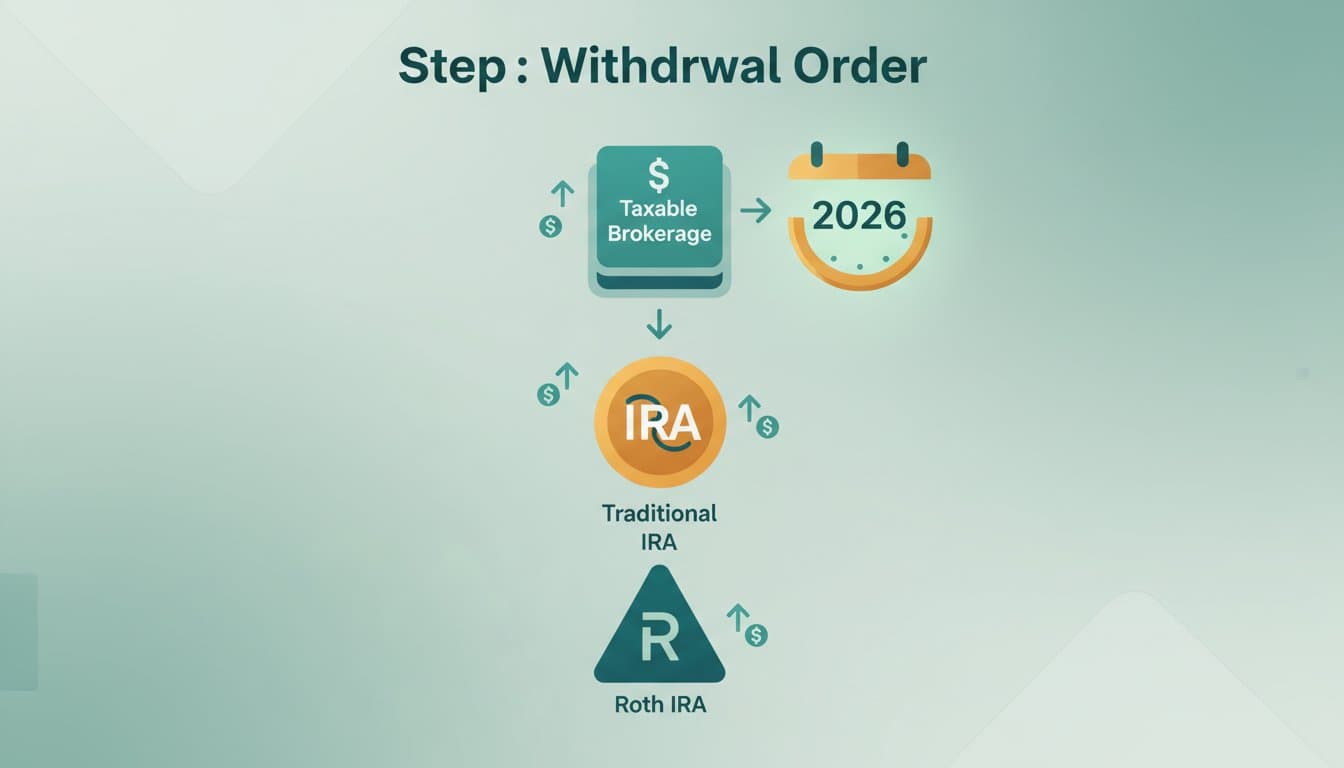
The 2026 Tax-Efficient Withdrawal Order: A Step-by-Step Guide
Follow this general sequence as a blueprint. Your personal situation may require adjustments, but this order serves as the foundation for a smart retirement portfolio drawdown.
Step 1: Required Minimum Distributions (RMDs)
A Required Minimum Distribution (RMD) is the minimum amount the IRS requires you to withdraw annually from tax-deferred retirement accounts like traditional IRAs and 401(k)s, starting at age 733. If you are age 73 or older in 2026, you must start here. The SECURE 2.0 Act raised the RMD age to 73 for those who turn 72 after December 31, 2022. You are legally required to withdraw a specific percentage from your pre-tax retirement accounts like traditional IRAs, 401(k)s, and SEP IRAs. Fail to take an RMD, and the IRS imposes a steep 25% penalty on the amount you should have withdrawn4. Satisfy this obligation first before moving to other, more flexible sources.
Step 2: Taxable Brokerage Account Income
A taxable brokerage account is a standard investment account that holds stocks, bonds, mutual funds, and other securities, where you pay taxes on interest, dividends, and capital gains as they occur rather than deferring taxes like retirement accounts5. After covering RMDs, turn to your regular taxable investment account. Withdrawals here are taxed favorably. You only pay tax on the growth (capital gains), not the original principal you contributed. Furthermore, long-term capital gains (on assets held over one year) are taxed at 0%, 15%, or 20%, depending on your total income6. For many retirees, this rate is lower than their ordinary income tax rate. Using this money can cover living expenses without significantly increasing your taxable income.
Step 3: Additional Pre-Tax Account Withdrawals (Traditional IRA/401(k))
A Traditional IRA is an individual retirement account that offers tax-deductible contributions with taxed withdrawals in retirement, while a 401(k) is an employer-sponsored retirement plan with similar tax treatment. If you need more money beyond RMDs and brokerage account funds, strategically tap your traditional IRAs and 401(k)s. The goal is to fill up your current tax bracket without spilling into the next one. For example, if the 12% bracket tops out at $24,300 of taxable income for single filers as of 2026, you would withdraw just enough from these accounts to reach that limit. This "filling the bracket" strategy converts pre-tax money at a known, relatively low rate, reducing the account balance and future RMDs.
Step 4: Roth IRA Contributions (Your Tax-Free Reservoir)
A Roth IRA is a retirement account funded with after-tax dollars, allowing tax-free withdrawals of contributions and, if certain conditions are met, tax-free earnings in retirement. Your Roth IRA is your most powerful tool for tax control. You can withdraw your original contributions (not the earnings) at any time, for any reason, completely tax-free and penalty-free7. Use Roth money if you need to cover an expense that would otherwise force you into a higher tax bracket by taking too much from a pre-tax account. It acts as a pressure release valve for your tax plan.
Step 5: Roth IRA Earnings and Social Security
This is your last line of defense. Leave Roth IRA earnings untouched until age 59½ to avoid penalties, and ideally until much later to preserve their tax-free growth. Similarly, delaying Social Security past your Full Retirement Age increases your benefit by 8% per year up to age 708. The longer you can fund your lifestyle with other assets, the larger your guaranteed, inflation-adjusted Social Security check will be. For retirees with variable earnings histories—especially those who were self-employed—maximizing this benefit is crucial.
The 2026 Tax Bracket Reset: Why Order Matters More This Year
The provisions from the 2017 Tax Cuts and Jobs Act (TCJA) are scheduled to sunset after 2025 unless Congress extends them9. If the sunset takes effect, the top marginal rate reverts to 39.6%, and the thresholds for the 32%, 35%, and top brackets compress—meaning the same dollar of traditional IRA withdrawal could push you one bracket higher in 2026 than it would have in 2025.
The 10%, 12%, 22%, and 24% brackets are projected to remain identical under current law for lower income ranges. The structural change hits upper-middle incomes: a retiree with roughly $200,000 in combined RMDs, Social Security, and pension could see their marginal rate jump from 24% to 32% without any change to their withdrawal habits.
Why this matters for your order: every extra dollar you front-load from Roth or taxable accounts in a low-bracket year buys you "bracket space" you may no longer have after 2026. That is the principle behind Step 3's "fill the bracket" rule—but 2026 makes the ceiling on today's bracket matter more than the floor of the next one.
Special Considerations for Self-Employed Retirees
If you worked as a freelancer, consultant, or 1099 contractor during your career, a few factors deserve extra attention.
- Variable Income History: Your Social Security benefit is based on your 35 highest-earning years. If you had years with very low or no reported income, your benefit may be lower than a W-2 employee's. This makes optimizing your withdrawal order even more critical to supplement your income.
- No Employer Pension: You likely don't have a traditional pension. Your retirement income is entirely self-funded, placing a greater emphasis on efficient drawdown from your own accounts.
- SEP IRA or Solo 401(k) RMDs: If you saved using a SEP IRA or a traditional Solo 401(k), those funds are subject to RMDs just like any other pre-tax account. Factor them into your Step 1 calculations.
Advanced: Using Roth Conversions to Front-Load Low Brackets
A Roth conversion moves funds from a traditional IRA to a Roth IRA, with the converted amount taxed as ordinary income in the year of conversion. The strategic logic: pay tax today at a known, controlled rate—before RMDs start at 73, and before the 2026 bracket compression—to avoid being forced into a higher rate later.
Example. A married couple, both age 68, living on taxable account funds and a small pension, sits in the 22% bracket with $1.2M in a traditional IRA. Each year between retirement and age 73, they could convert just enough to fill the top of the 24% bracket. They pay 24% today in exchange for avoiding forced RMDs that would land them in the 32% or 35% bracket post-2026—and they cut their future IRMAA exposure at the same time.
Two practical rules:
- The five-year rule for accessing converted funds does not apply once you are over 59½7, so conversions remain flexible.
- Execute conversions in your lowest-income years—before Social Security starts, or in gap years between part-time work ending and age 73.
Coordinating spouses. Surviving spouses face single-filer brackets, which are roughly half as wide as joint brackets. A household comfortable in joint-filer rates today can see the survivor pushed two brackets higher. A multi-year Roth conversion plan reduces the future tax load for whichever spouse survives. Model every conversion against the "single survivor" scenario, not just the joint-filer year in front of you.
Roth conversions are not a one-time event—they are an annual tax-management exercise, and they pair with the withdrawal order above rather than replace it.
The Two Tax Torpedoes: Social Security & Medicare IRMAA
Your withdrawal order directly impacts how much of your Social Security is taxable. Up to 85% of your benefits can be subject to federal income tax depending on your "combined income"10. A poorly timed large withdrawal from a traditional IRA can push your income over the threshold, causing more of your Social Security to be taxed—a double whammy known as the "tax torpedo."
The second torpedo is Medicare IRMAA (Income-Related Monthly Adjustment Amount). When your modified adjusted gross income (MAGI) crosses certain thresholds—roughly $106,000 single or $212,000 joint for 2026—your Medicare Part B and Part D premiums jump to a surcharge tier11. Because IRMAA is based on your tax return from two years prior, a large 2026 withdrawal from a traditional IRA or 401(k) can raise your 2028 Medicare premiums. A strategic withdrawal order that leans on taxable and Roth funds early helps you dodge both torpedoes at once.
Sample Withdrawal Order for a 68-Year-Old Retiree in 2026
Let's assume Jane is 68, not yet taking RMDs, and needs $60,000 for the year. She saved through a mix of an employer 401(k), a Roth IRA, and a taxable brokerage account during her career.
| Account Type | Amount Withdrawn | Tax Treatment | Rationale |
|---|---|---|---|
| 1. Taxable Brokerage | $25,000 | Mostly tax-free return of principal; some long-term capital gains at 0%/15% | Minimizes taxable income. Uses cost basis first. |
| 2. Traditional IRA | $20,000 | Ordinary income tax | Fills up the lower part of her tax bracket (e.g., up to the top of the 12% bracket). |
| 3. Roth IRA (Contributions) | $15,000 | Tax-Free and Penalty-Free | Covers the remaining need without increasing her taxable income at all, keeping her below key thresholds. |
| Total Income | $60,000 | Controlled Taxable Income: ~$20,000 | Her taxable income is only the Traditional IRA withdrawal, keeping her tax bill low. |
Key Tools and Account Types Summary
| Account Type | Tax Treatment on Withdrawal | Key Withdrawal Rule | Best Use in Strategy |
|---|---|---|---|
| Taxable Brokerage | Principal: Tax-Free. Gains: Capital Gains Tax. | Anytime. | Step 2. Cover expenses with minimal tax impact. |
| Traditional IRA/401(k) | Ordinary Income Tax. | RMDs start at age 73. Penalty before 59½. | Steps 1 & 3. For RMDs and filling lower tax brackets. |
| Roth IRA | Contributions: Tax/Penalty-Free. Earnings: Tax-Free after 59½ (if account is 5 yrs old). | Contributions anytime. Earnings after 59½. | Step 4 (Contributions). Tax-free funding to control income. Step 5 (Earnings). Last resort/long-term growth. |
| Social Security | 0-85% taxable based on income. | Can start at 62, increases to 70. | Step 5. Delay to maximize benefit, then coordinate with other withdrawals to minimize taxation. |
Your Action Plan for 2026
A retirement withdrawal strategy is not a one-time decision. It's an annual exercise in tax planning.
- Project Your Income: Estimate all your income sources for the year: Social Security, pensions, dividends, interest, any part-time work, etc.
- Calculate Your Tax Bracket Space: Determine how much "room" you have in your current tax bracket before hitting the next one.
- Follow the Order: Withdraw from accounts in the sequence outlined above to fill your income needs while staying within your target tax bracket.
- Review Annually: Tax laws and your personal needs change. Revisit this plan every year, ideally with a financial advisor or CPA who understands retirement income planning and Medicare IRMAA thresholds.
Applying this proactive mindset to retirement distributions is the final critical step to stretching your savings and securing your financial independence. Start mapping out your 2026 withdrawal order today.
Start mapping out your 2026 withdrawal sequence using the priority order above, and consult a licensed CPA to tailor it to your specific tax situation. For more tax-smart retirement strategies, explore our other retirement planning guides.
Disclaimer: This article is for educational purposes only and does not constitute tax or financial advice. Tax laws are subject to change, and individual circumstances vary. Consult a licensed CPA or financial advisor for personalized guidance on your retirement withdrawal strategy.
Footnotes
-
IRS Topic No. 424, 401(k) Plans, https://www.irs.gov/taxtopics/tc424 ↩
-
Congressional Research Service, "The Tax Cuts and Jobs Act: Overview and Analysis," https://crsreports.congress.gov/product/pdf/R/R47438 ↩
-
IRS Retirement Plan and IRA Required Minimum Distributions FAQs, https://www.irs.gov/retirement-plans/retirement-plan-and-ira-required-minimum-distributions-faqs ↩ ↩2
-
IRS Penalty for Not Taking RMDs, https://www.irs.gov/retirement-plans/plan-participant-employee/retirement-topics-exceptions-to-tax-on-early-distributions ↩
-
IRS Tax Topics - Investment Income, https://www.irs.gov/taxtopics/tc409 ↩
-
IRS Topic No. 409, Capital Gains and Losses, https://www.irs.gov/taxtopics/tc409 ↩
-
IRS Roth IRA FAQs, https://www.irs.gov/retirement-plans/roth-iras ↩ ↩2 ↩3
-
Social Security Administration, "Starting Your Retirement Benefits Early," https://www.ssa.gov/benefits/retirement/planner/agereduction.html ↩
-
Congressional Research Service, "The Expiration of the Tax Cuts and Jobs Act's Individual Income Tax Provisions," IN12229, December 2023, https://crsreports.congress.gov/product/pdf/IN/IN12229 ↩
-
IRS Topic No. 423, Social Security and Equivalent Railroad Retirement Benefits, https://www.irs.gov/taxtopics/tc423 ↩
-
Medicare.gov, "Part B costs," https://www.medicare.gov/your-medicare-costs/part-b-costs ↩ ↩2